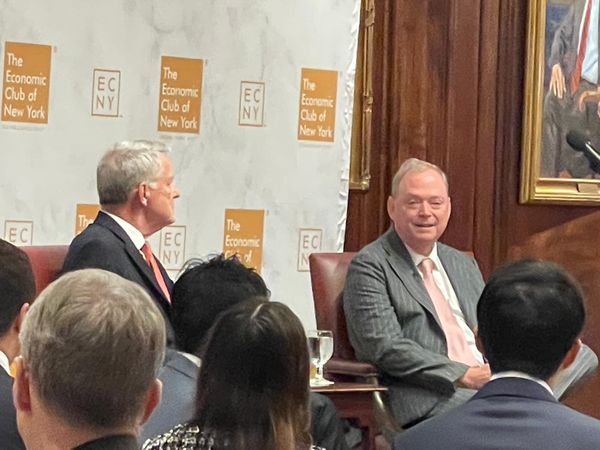
I met Dr. Alain Labrique in New York during the UNGA week with four questions for what was meant to be a relatively short conversation. We ended up talking longer than planned — something I was genuinely grateful for, because it gave me the opportunity to learn much more than I expected.
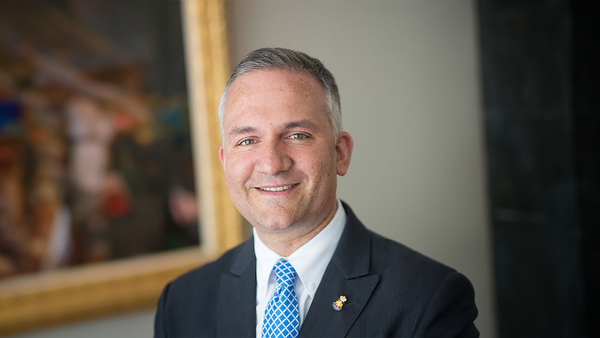
Labrique is Director of the Department of Data, Digital Health, Analytics and AI at the World Health Organization, a former professor of international health at Johns Hopkins University and founding director of the Johns Hopkins Global mHealth Initiative.
Our conversation began where seemingly every conversation about technology begins these days: artificial intelligence.
But it quickly became a conversation about something much bigger: how health systems are built, whom they are built for, and what happens when technology moves faster than the institutions responsible for using it safely.
AI: enthusiasm, with caution
WHO, Labrique told me, is “very cautiously enthusiastic” about artificial intelligence.
And one of his first points was also one of the simplest: AI is not one thing.
Machine learning, computer vision and pattern recognition have been operating around us for years. Generative AI and the chatbots now attracting extraordinary public attention represent only part of a much larger field.
Labrique used an analogy I particularly liked: think of AI as a zoo. There are llamas. And there are tigers. You might comfortably reach out and touch one; you probably should not treat the other the same way.
Different systems therefore require different levels of oversight, different safeguards and different standards for determining whether something is actually good enough to be used in healthcare.
That distinction matters because governments are already facing enormous pressure from companies offering AI solutions. The question is no longer simply whether a technology exists. It is whether it is safe, effective, affordable and appropriate for the population where it will actually be used.
A model trained primarily on one population may provide inappropriate guidance to someone living somewhere entirely different. National medical guidelines differ. Available medicines differ. Health systems differ.
And in medicine, mistakes are not merely inconvenient.
WHO’s position, Labrique explained, is that systems must be fit for purpose, trained on reliable information, constrained appropriately and capable of recognizing when they have reached their limits.
At that point, the machine needs to defer to a person.
“In healthcare, in public health, the uses of AI, so far we are very insistent that there be clear clarity of human oversight.”
Clinical decisions and prescriptions, he stressed, still require human responsibility. A machine cannot assume a clinician’s duty of care.
The problem with the shiny object
There is another problem with the current enthusiasm around technology: sometimes we become fascinated by the solution before asking whether the system around it can actually support it.
I mentioned conversations I had heard throughout UNGA about the potential of AI in lower-resource countries. The promise sounds enormous, but what happens when people do not reliably have devices, electricity or internet access?
Labrique said this goes to the heart of a problem WHO has watched for decades.
For 25 or 30 years, he said, countries have experienced waves of technological “solutionism”: an exciting product arrives, funding supports it for a period, and then the money disappears.
So does the project.
He has seen what he called “graveyards of technology” — equipment abandoned because there was no maintenance, no spare part, no training or no sustainable financing behind it.
Giving a community an ultrasound machine, for example, does not by itself reduce maternal mortality. Someone has to know how to operate it. The equipment has to remain calibrated. Parts must be available. Someone has to budget for keeping it functioning.
The lesson is not anti-technology; it is almost the opposite.
If technology is going to matter, it has to become part of the health system rather than temporarily sit on top of it. And increasingly, that conversation begins with infrastructure: electricity, connectivity, digital networks.. but also something even more fundamental: identity.
More than a billion people globally, Labrique noted, lack formal identification. Without it, providing many digital public services becomes extraordinarily difficult.
Then there is another form of infrastructure most of us encounter only when it fails: our own medical history.
What if your health record actually followed you?
This part became unexpectedly personal.
Labrique explained that in many places, every encounter with a new doctor effectively begins from zero, even though your medications, surgeries, allergies, diagnoses and previous tests are all part of the medical history sitting in front of that clinician.
Without that history, doctors may need to repeat tests, may lack crucial information about previous reactions, and, especially in emergencies, may be making decisions about an unconscious patient without information that could determine whether the treatment is appropriate.
I smiled when he said it because I had very recently experienced exactly why this matters. While receiving treatment for anemia in New York, I was given Benadryl before an IV without realizing it. I am allergic to it. The reaction was immediate. And this was not happening somewhere without modern hospitals or sophisticated technology. It was happening in New York City in 2026.
That exchange led us into something WHO is trying to build that receives considerably less attention than generative AI but may eventually affect billions of people: a system allowing health credentials and records to be verified across borders.
WHO's Global Digital Health Certification Network now includes 82 countries, representing roughly 2.1 billion people, according to Labrique.
The basic idea is surprisingly intuitive.
A health credential could establish, for example, that you received a vaccination, require a particular medication or possess a verified medical record issued by an authorized institution. A receiving country can verify that the source is genuine and that the credential has not been altered. WHO itself does not hold or transmit the person's medical data, Labrique emphasized.
Instead, he compared the system to what happens when we use a credit card abroad. The restaurant does not receive access to your entire bank account. It simply has a way to determine that the credential you presented is valid and was issued by a trusted institution.
WHO essentially helps establish that international layer of trust between health authorities.
And the implications can become very practical.
Could you eventually take a prescription issued in one country and have it recognized in another?
That is part of what countries are working toward. Labrique pointed to increasing cross-border acceptance of digital prescriptions within Europe. Each country still decides which information it is willing to recognize: prescriptions, allergies, conditions or other records.
The United States, he confirmed during our conversation, is currently not one of the 82 countries participating in the network.
Build before the emergency
There was a sentence in this part of our conversation that stayed with me:
“When you're in an emergency, it's not the time to build that kind of infrastructure.”
The network grew out of one of the lessons of the COVID-19 pandemic.
You cannot wait until the next global health emergency and then begin figuring out how countries will verify information, communicate with one another and move health credentials across borders.
The pipes need to exist before you need the water.
And when I asked Labrique what development over the next five years could most meaningfully change access to healthcare, he came back to that idea of a global trust infrastructure and to a personal health record that could follow an individual wherever life takes them.
The objective is ultimately quite human: your health information available when and where you need it, supported by common standards that allow systems built in entirely different places to communicate with one another.
The technology we don't see
Perhaps my favorite analogy of our conversation had nothing to do with AI.
It was plumbing.
We appreciate turning on a faucet and getting water. We generally do not think about the pipes underneath the building, the connections to the municipal system, or all of the infrastructure that makes that simple moment possible.
Digital health increasingly works the same way.
The public conversation gravitates toward the shiny object — the app, the AI tool, the device. But much of what determines whether any of it works is invisible: standards, networks, identity systems, interoperability, infrastructure and governance.
Labrique believes health has an opportunity now to do something other sectors have already done: rethink the system itself.
Banking, transportation and travel have been transformed by the digital age; health, Labrique argued, still carries too many processes designed for paper, and changing that requires “leadership, vision, courage and technology” together.
Why this conversation mattered to me
There is something unfashionable about science right now.
Its most truthful answer is very often: it depends... on the population, evidence, infrastructure, technology. It depends on what exactly we are trying to accomplish.
Nuance does not travel particularly well in an information environment built around certainty, outrage and whatever can be made most colorful in a headline.
But reality remains nuanced whether the algorithm rewards it or not.
And when the next actual emergency arrives — another pandemic, another humanitarian crisis, another moment when health systems suddenly matter to everyone — the institutions and people doing this quieter work will still be there.
That was ultimately my impression after speaking with Dr. Labrique.
WHO describes itself, and Labrique repeatedly described its role, as a science-based institution: bringing evidence and technical guidance to countries while leaving sovereign decisions to governments themselves. In countries with strong domestic institutions, that may mean supporting systems that already possess considerable capacity. Elsewhere, WHO may work alongside ministries that are still building it.
Behind all of those enormous institutional words are people.
Dr. Labrique was generous with his time, careful with his explanations and remarkably personable. What was supposed to be a short conversation ran longer because he clearly cared about making complicated things understandable.
And I left grateful for it.
We spend an extraordinary amount of time consuming headlines about institutions and considerably less time understanding the professionals actually doing the work inside them.
When those institutions have knowledgeable people who genuinely care about the systems they are responsible for building, I think it is worth knowing who they are.
It is worth listening to them.
And it is worth learning from them.
That is part of what ONEST Voices is for.
Learn more about the World Health Organization and its work on digital health here: https://www.who.int/health-topics/digital-health
This is what ONEST is built for.
Direct conversations with the people shaping policy, science and global institutions — with the time to ask what actually matters.
ONEST members receive The Daily, Diplomatic Notes, deeper analysis and members-only audio from conversations like this one.
Join ONEST — $199/year or $19.99/month.
Know what mattered today — before tomorrow’s headlines.
Join ONEST