Ukraine at 35: Independence Day Brings New Defense Deals, Missiles and a Show of Allied Support

– 6 min read

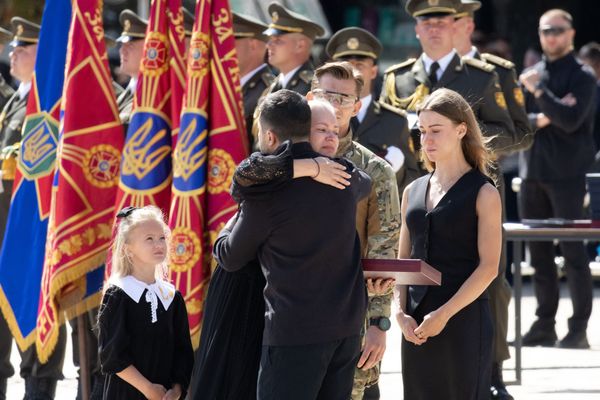
This year, Ukraine marked its 35th Independence Day not with the traditional military parade that once moved through central Kyiv, but with something much more representative of the country fighting to preserve that independence.
At dawn, Ukrainian-made ground robotic systems moved along Khreshchatyk. Naval drones crossed the Dnipro. Interceptor and combat drones took to the sky alongside military aircraft.
The unusual display amounted to a parade of the technologies that have increasingly defined Ukraine’s defense on land, at sea and in the air.
It also followed a weekend in which Kyiv became a gathering point for some of Ukraine’s closest partners.
Saturday, August 23, was Ukraine’s National Flag Day. Leaders from the Nordic and Baltic countries arrived in Kyiv for the second Ukraine-Nordic-Baltic Eight (NB8) summit, while other foreign officials and delegations joined events leading into Independence Day.
The result was more than symbolism.
Across two days, Ukraine announced new defense-industrial agreements, expanded cooperation on drones and long-range weapons, pressed allies for urgently needed air defense missiles and winter energy support, and made the case that defending Ukrainian independence increasingly means integrating Ukraine directly into Europe’s defense architecture.
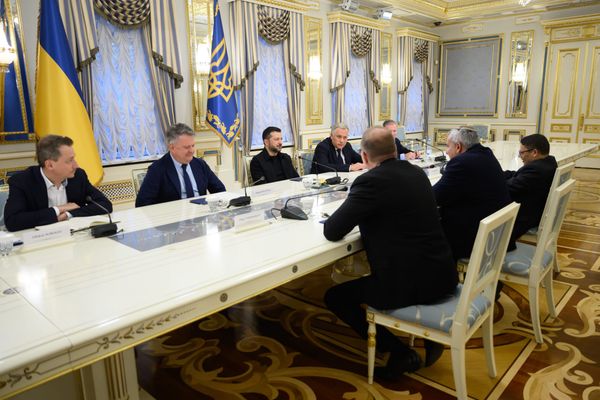
President Volodymyr Zelenskyy hosted leaders of the Nordic-Baltic Eight (Denmark, Estonia, Finland, Iceland, Latvia, Lithuania, Norway and Sweden) for talks focused heavily on what Ukraine will need as another winter of Russian attacks approaches.
Kyiv’s immediate concerns are very concrete.
Zelenskyy told the leaders that ballistic missiles remain one of the most serious threats facing Ukraine and made air defense the first priority. He thanked countries participating in the FREYJA anti-ballistic initiative and those financing U.S.-made weapons through the PURL mechanism.
“Every missile means lives saved,” Zelenskyy said.
Ukraine is also preparing for another Russian campaign against its energy infrastructure while seeking additional gas supplies and replacement equipment ahead of winter. Russian attacks on ports remain another concern, with consequences extending beyond Ukraine through disruptions to food exports.
And there is a substantial financing problem.
Zelenskyy said Ukraine faces an overall $27 billion defense budget deficit, in part because money originally intended for later in the year has already been pulled forward to pay for drones and other urgent battlefield requirements.
Kyiv is proposing that part of European financing currently planned for 2027 be accelerated. Zelenskyy said approximately €10 billion is needed to ensure that weapons already being manufactured, including in Europe, can actually reach Ukrainian forces in January and February.
This is increasingly the central problem facing Ukraine’s defense industry: not simply whether weapons can be built, but whether enough money is available to order them at scale.
The discussions also covered sanctions against companies and individuals involved in Russia’s ballistic missile production, its shadow fleet, frozen Russian assets and Ukraine’s EU accession process.
Ukraine wants the remaining four negotiating clusters in its EU membership talks opened.
Finland brought more than political support to Kyiv.
President Alexander Stubb arrived with representatives of seven Finnish companies, and Ukrainian and Finnish companies signed three cooperation documents spanning the land, maritime and air domains.
The agreements involve Insta, Boomeranger and Patria, alongside Ukrainian counterparts.
The significance is larger than individual contracts.
Ukraine spent the first years of the full-scale war urgently importing weapons from partners. Increasingly, the relationship is becoming two-directional: European companies provide capital, manufacturing capacity and access to supply chains, while Ukraine contributes battlefield-tested technology, rapidly developed systems and operational experience that European militaries themselves want.
As Stubb put it, industrial cooperation is now moving across “land, sea, and air.”
Ukraine and Norway also moved beyond individual aid packages.
Zelenskyy and Norwegian Prime Minister Jonas Gahr Støre signed an agreement on defense and security cooperation under Ukraine’s Drone Deal framework as well as a broader declaration establishing a strategic partnership between the two countries.
The strategic agreement has been named the Ellisiv Accord, after Ellisiv of Kyiv, the daughter of Yaroslav the Wise who became Queen of Norway.
The agreements build a longer-term framework around defense, technology, energy and resilience rather than treating Norwegian assistance as a sequence of emergency packages.
Zelenskyy also thanked Norway for its intention to maintain substantial support, pointing to roughly $9 billion planned for 2027.
That shift matters.
Ukraine’s argument to its partners is increasingly that the war should not be viewed as a temporary interruption followed by a return to the old European security system. Ukraine wants its defense industry, technology and armed forces embedded in whatever replaces that system.
Britain is also moving beyond simply supplying long-range missiles.
On Ukrainian Independence Day, Defence Minister Luke Pollard said the UK is sharing technology with Ukraine that will enable it to build Storm Shadow missiles on Ukrainian soil.
“We’re sharing technology with Ukraine that will enable them build Storm Shadow missiles on their own soil,” Pollard said from Devonport, adding: “We will stand with them for as long as it takes.”
That is a significant shift.
Supplying Ukraine with individual Storm Shadow missiles gives Kyiv long-range strike capability. Helping Ukraine manufacture them domestically begins to reduce dependence on the pace and politics of future allied deliveries.
The announcement came as Prime Minister Andy Burnham visited Kyiv and handed President Volodymyr Zelenskyy technical material related to the missile program.
Russia responded immediately.
Kremlin spokesman Dmitry Peskov accused Britain of taking part in the war on Ukraine’s side and of “systematically and regularly adding fuel to the fire” by providing Ukraine with information needed to produce missiles. He also accused the British government of obstructing a peaceful settlement.
But from London’s perspective, the policy is increasingly explicit: Ukraine should not only receive Western weapons, it should gain the capacity to produce more of them itself.
Burnham also joined Zelenskyy and other European leaders for a new meeting of the Coalition of the Willing, co-chaired by Britain, France and Germany.
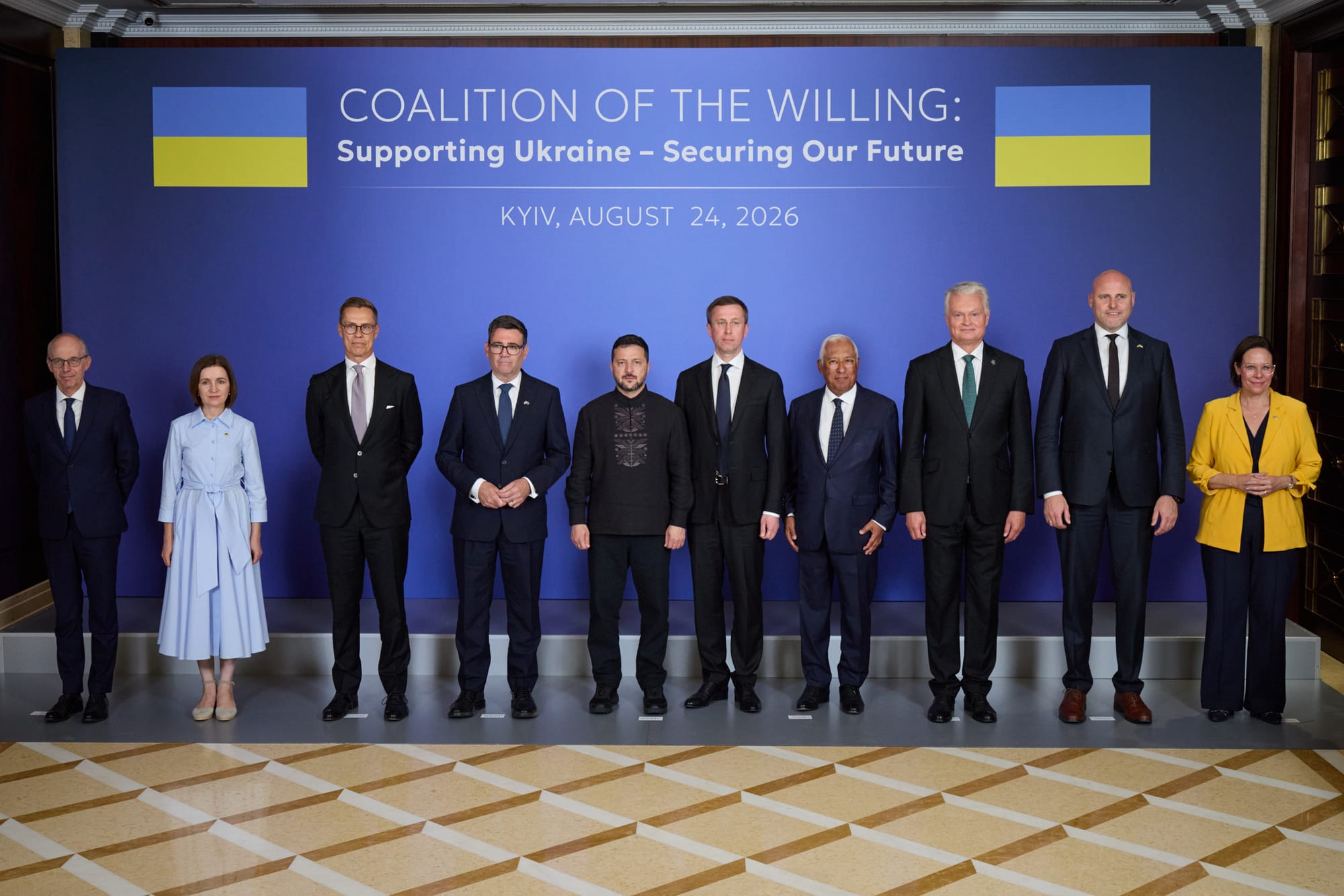
Air defense dominated the discussion.
Canada joined the meeting virtually.
Prime Minister Mark Carney reiterated Canada’s commitment to Ukraine, including more than $2 billion in military assistance this year, and highlighted Ukraine’s role as a founding member of the Defence, Security and Resilience Bank.
The leaders also discussed air defense, energy security, critical infrastructure, stronger sanctions including measures against Russia’s shadow fleet, and preparations for winter.
The immediate concern is simple: missiles to stop missiles.
Zelenskyy’s own Independence Day message to Vladimir Putin was considerably less diplomatic.
“Putin hopes that we are tired. We know that he is mortal,” Zelenskyy said.
“He never understood us and now he will not have time to.”
Zelenskyy pointed to Ukrainian strikes on Russian oil infrastructure, damage to Russia’s Black Sea Fleet and the economic consequences of Ukraine’s expanding campaign against targets inside Russia.
“You wanted us to disappear from the map,” he said. “Now you are disappearing from the international agenda of the future civilization.”
The broader Ukrainian strategy is increasingly visible: defend cities against Russia’s long-range attacks while increasing the economic and logistical cost of the war inside Russia itself.
Former U.S. Vice President Mike Pence was also in Ukraine around the Independence Day events.
After visiting Kyiv, Pence said Ukraine’s determination appeared stronger than when Russian forces launched the full-scale invasion in 2022 and argued that Ukraine could prevail with continued American and allied support.
“Ukraine is winning this war,” Pence said, calling its fight one for both Ukrainian freedom and the broader free world.
Thirty-five years ago, Ukraine declared independence from the Soviet Union.
Today, independence is being measured differently.
It is measured in whether Ukrainian cities can survive another winter of Russian missile attacks.
Whether Ukrainian factories can produce enough drones and missiles.
Whether European partners will finance weapons before existing budgets run out.
Whether sanctions can constrain Russia’s ability to replenish its own arsenal.
And whether relationships created in wartime become permanent defense partnerships rather than disappearing when the immediate emergency ends.
That made this year’s unusual Independence Day parade particularly fitting.
There were no crowds watching columns of conventional military hardware move through central Kyiv.
Instead, robots rolled down Khreshchatyk. Uncrewed boats crossed the Dnipro. Ukrainian drones filled the sky.
And around them, Ukraine was signing the agreements intended to build whatever comes next.