Good evening,
Welcome to Day 2 of 5 of ONEST’s public UNGA81 Daily Briefs.
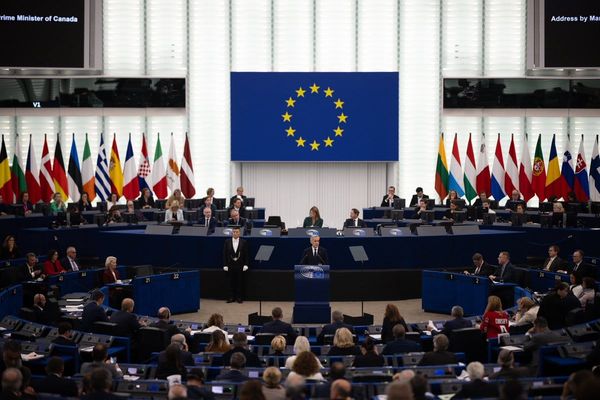
Today, the General Debate opened at the United Nations and President Donald Trump used his address to make a broad case for American power, sovereignty and military strength.
But several of the day’s most consequential developments happened outside the speech itself.
The United States, Denmark and Greenland signed a new Arctic security agreement. Trump met Ukrainian President Volodymyr Zelenskyy. His envoys held hours of talks with Iranian representatives. Washington unveiled a new hemispheric security framework. Canada used a packed day of bilaterals to deepen ties around critical minerals, defense and investment. And in the Gulf, the question is no longer simply when the Strait of Hormuz reopens, but how much of the region’s energy system will be rebuilt to bypass it.
I began the day with Trump’s UNGA address, followed the diplomacy around it throughout the afternoon, and also spent part of the day at a UN event focused on financing health care for women, children and adolescents.
Here’s what mattered.
Trump came to the UN with one central argument: America will act
Trump’s address was not a traditional defense of multilateralism, rather an argument that American power should be used directly when Washington believes existing institutions or diplomacy are failing to produce the result it wants.
He used the address to defend his administration’s approach to Iran, the Western Hemisphere, cartels, migration and international institutions, while repeatedly emphasizing U.S. sovereignty and military power.
Iran occupied a significant portion of the speech. Trump again said the United States would not allow Iran to obtain a nuclear weapon and presented Tehran with a stark choice between reaching an agreement and facing further military action. He also argued that Washington would no longer allow threats to establish themselves in the Western Hemisphere and rejected what he described as "international efforts to impose controls on the United States".
The speech moved quickly from Iran to Ukraine, Venezuela, Mexico, Cuba, Greenland, the International Criminal Court and global taxation.
That pace itself was striking. The individual issues were different, but the governing idea connecting them was consistent: national sovereignty first; international institutions only where Washington finds them useful; direct American power when it does not.
DIPLOMATIC NOTE FOR ONEST MEMBERS
I recorded a separate Diplomatic Note immediately after Trump’s UNGA address with my reaction and observations from the room, including what stood out beyond the prepared headlines and what I think deserves closer attention as the week continues.
Then came Greenland.. and the actual agreement is substantial
Later in the day, the United States, Denmark and Greenland signed a new Arctic security agreement.
The agreement formally reaffirms the sovereignty and territorial integrity of the Kingdom of Denmark and recognizes Greenlanders’ right to self-determination. It does not transfer Greenland to the United States.
But militarily, it significantly expands the framework for U.S. activity there.
The United States will be allowed to modernize and expand operations at Pituffik Space Base, establish additional defense areas at Narsarsuaq and Mestersvig, and potentially seek further defense areas through consultation with Denmark and Greenland.
It also provides broad U.S. military access between defense areas by land, air and sea, including overflight and movement through Greenland’s territorial waters.
The economic-security provisions are just as notable.
The agreement allows restrictions on investors from states outside NATO, NATO partnerships or the EU where they could gain control, significant influence or sensitive information in sectors including critical infrastructure and resource extraction.
And it has no end date. The agreement also anticipates the possibility of future Greenlandic independence while preserving the defense framework.
So this is much more than another argument over Trump’s interest in Greenland. It rather creates a durable framework around U.S. military access, NATO activity, Arctic infrastructure and investment screening.
Trump and Zelenskyy: diplomacy, Patriots and Russian energy strikes
Trump then met Ukrainian President Volodymyr Zelenskyy on the sidelines of UNGA. According to Ukraine’s presidency, they discussed possible de-escalatory steps, a winter air defense package and work toward Patriot interceptor production in Ukraine.
Zelenskyy later said the discussion also included a possible energy truce with Russia. Reuters reported that he said Ukraine was prepared to consider such a format.
Trump, meanwhile, again raised the effect of Ukrainian strikes inside Russia on diesel prices. During the bilateral, he described the attacks as a serious hit on Russia but also pointed to their impact on diesel markets. He separately said he supported the idea of restricting U.S. diesel exports as prices remain elevated.
Ukraine spent the rest of the day focused on the practical requirements of getting through another winter. Zelenskyy met European Commission President Ursula von der Leyen about financial resilience and sanctions, Danish Prime Minister Mette Frederiksen about sanctions and joint defense production, and IMF Managing Director Kristalina Georgieva about financing for next year. The thread running through those meetings was straightforward: air defense, money, sanctions and industrial capacity before winter.
Iran is negotiating, while Hormuz traffic has almost stopped
One of the most consequential developments of the day came away from the General Assembly floor.
A senior Iranian official told Reuters that Iran could reopen the Strait of Hormuz within seven days if the United States eases military pressure and lifts its blockade on Iranian ports.
The offer comes though as traffic through the Strait has collapsed. Preliminary shipping data showed only two commodity vessels crossed Hormuz on Monday, down from 10 the previous day and far below the roughly 125 large commercial vessels that transited daily before the current conflict. Reuters cautioned that vessels operating without active tracking transponders may not be captured in the data.
At the same time, Trump said Steve Witkoff and Jared Kushner held a roughly three-hour meeting with members of an Iranian delegation in New York and that another meeting was expected soon. That creates an extraordinary contrast with the rhetoric from the UN podium. Washington is threatening substantially more force while simultaneously pursuing direct negotiations.
..and the planning is already moving beyond the immediate conflict.
The Trump administration has proposed a $5 billion U.S. contribution to a new Gulf energy fund intended to rebuild damaged infrastructure and reduce regional dependence on Hormuz, according to reporting by The Wall Street Journal. The proposal seeks matching regional contributions for a potential $10 billion fund; Reuters said it could not independently verify the report.
Britain, meanwhile, has agreed to provide Saudi Arabia with limited defensive air-to-air refueling support as Houthi attacks continue. The G7 foreign ministers have called on Iran to stop supplying and supporting the Houthis, arguing that the escalation threatens both regional stability and international trade.
This is no longer simply a story about whether Hormuz reopens. The Gulf is already being forced to think about how much of its energy, transport and security infrastructure must be redesigned around the possibility that Hormuz cannot always be treated as a guaranteed artery.
Washington is building a new security framework in the Western Hemisphere
The United States and fourteen other governments announced the Shield of the Americas, built around three pillars: economic cooperation, security and multilateral coordination.
The initiative includes plans for cooperation on critical mineral supply chains, investment screening, digital infrastructure, intelligence sharing and security technologies.
Its first joint action targets 24 organizations identified by participating governments as narco-terrorist or criminal organizations, with measures that could include asset freezes, visa restrictions and criminal liability for material support.
The participating states also intend to seek action through the Organization of American States and the Rio Treaty framework.
This makes the initiative broader than a cartel crackdown: it places security policy, investment policy, critical minerals and supply chains inside one hemispheric framework.
It also fits neatly with the doctrine Trump articulated from the General Assembly earlier today: a much greater emphasis on securing the Western Hemisphere politically, economically and militarily.
Canada is using UNGA to diversify.. again through critical minerals
Canadian Prime Minister Mark Carney spent much of today in bilateral meetings.
His official schedule included meetings with Chilean President José Antonio Kast, Angolan President João Lourenço, UAE Industry and Advanced Technology Minister Sultan Al Jaber and Jordan’s King Abdullah II.
With Chile, the discussion included defense and aerospace, critical minerals, Antarctic research and investment. Canada said it was already Chile’s largest foreign investor, with nearly C$40 billion invested there last year.
With Angola, Carney again focused on trade, mining and critical minerals, alongside ongoing negotiations over economic cooperation and investment protection.
And with Jordan, the focus shifted toward the Middle East, humanitarian conditions in Gaza and deeper defense cooperation.
Canada is trying to build a broader network of strategic economic relationships around minerals, defense, energy and investment. That theme is becoming difficult to ignore across the week as a whole.
Yesterday: Italy and the United States.
Today: Greenland, Chile, Angola and the Western Hemisphere.
Critical minerals are everywhere.
Inside UNHQ: health financing is colliding with shrinking resources
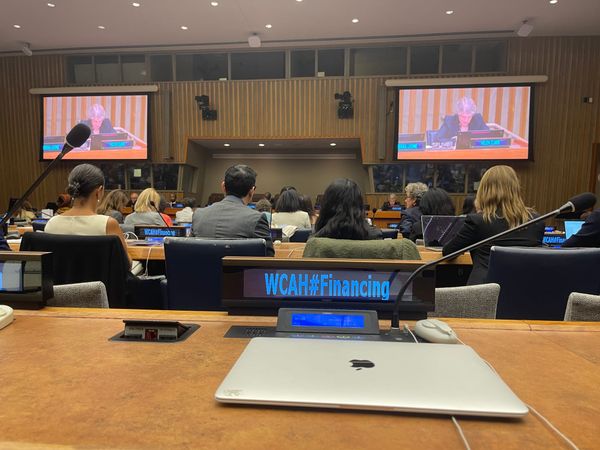
One of the quieter conversations I followed today at UN Headquarters was about financing health care for women, children and adolescents.
The central problem was straightforward: needs are rising while financing is becoming harder.
Representatives from South Africa, Spain, Sierra Leone, Kenya and other governments discussed the combined pressure of conflict, disease and declining financing on already strained health systems.
South Africa emphasized both the financing gap and underused opportunities for knowledge exchange.
Sierra Leone presented an effort aimed at eliminating preventable maternal deaths within 200 days and reported reductions in maternal and child mortality.
Kenya pointed to investment in additional midwives and health-care facilities as practical interventions rather than ceremonial commitments.
That conversation may not generate the biggest UNGA headline, but it gets directly at one of the central questions behind High-Level Week: can international cooperation still produce practical results when resources are getting tighter and crises are multiplying?
Also today
The United States announced plans for an additional $31 million in assistance for Nepal’s flood recovery, including bridge reconstruction, humanitarian support and U.S.-made drones intended to improve future disaster response.
At the Clinton Global Initiative, MISTR announced that it would fund one million free HIV tests and one million free hepatitis C tests by the end of 2027, connecting those who test positive directly with care.
And the U.S. and Türkiye announced a technical study of American small modular reactor and fourth-generation nuclear technologies — another example of energy security and industrial policy increasingly overlapping.
What I’m watching tomorrow
Tomorrow, Ukraine moves even further toward the center of the week’s diplomacy.
I’ll be following the Crimea Platform, Ukraine’s wider diplomatic push, Canada and Europe, maritime security, the Middle East, and the increasingly obvious overlap between security, energy, critical minerals and trade.
I’ll also continue reporting from New York throughout the day.
That’s Day 2 of 5.
See you tomorrow,
Olga
All five UNGA81 editions of The Daily are public this week.
ONEST members get the reporting beyond the public brief: Diplomatic Notes from my conversations, interviews and observations throughout the week, with audio and transcripts where available.
Become an ONEST member and unlock every UNGA81 Diplomatic Note immediately — including today’s note following President Trump’s UN General Assembly address.
Written by

Comments