How America Went From Paying Down Its Debt to $40 Trillion
This article is part of ONEST’s Financial & Geopolitical Literacy Series, made possible by generous donors who support independent ONEST journalism and allow us to keep this reporting public.
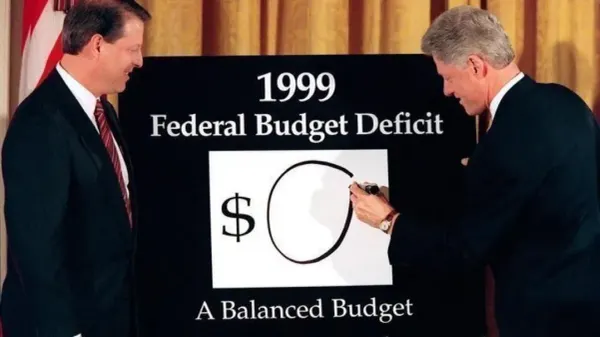
In 1998, President Bill Clinton walked in front of cameras with something almost unimaginable today: a federal budget surplus.
0:00
/1:05
For the first time since 1969, the United States government had taken in more money than it spent.
The surplus was relatively modest: $70 billion on roughly $1.7 trillion in federal revenue, but Washington believed something much bigger might be possible.
By 1999, the surplus had grown to $123 billion.
By 2000, it reached $237 billion.
And the Clinton administration began talking seriously about a future in which the federal debt held by the public could fall all the way to zero. In January 2000, Treasury Secretary Lawrence Summers said that if fiscal discipline continued, the government anticipated paying off publicly held debt within 15 years. Later projections moved that date as early as 2009 or 2010.
Twenty-six years later, the United States has gone in precisely the opposite direction.
On August 19, 2026, total federal debt crossed $40 trillion for the first time.
So what happened?
There was no single $40 trillion purchase.
There wasn't one president, one Congress or one war that created the debt.
Instead, America went through a series of shocks and policy choices that gradually transformed deficits from something associated largely with recessions and wars into a normal feature of the federal budget.
And now something else is happening.
The debt itself is becoming increasingly expensive.
First: what exactly is the national debt?
The easiest mistake is to confuse the deficit with the debt.
The deficit is an annual shortfall.
If the federal government collects $5.6 trillion in a year but spends $7.4 trillion, it is short approximately $1.8 trillion. It finances much of that difference by borrowing.
The debt is the accumulation of those borrowings over time.
For fiscal 2026, the Congressional Budget Office projects federal spending of about $7.4 trillion, against approximately $5.6 trillion in revenue, producing a deficit of roughly $1.9 trillion.
Then there is another important distinction.
The roughly $40 trillion figure is gross federal debt. It includes both Treasury securities held by investors and securities held inside government accounts.
Economists frequently focus instead on debt held by the public — Treasury debt owned outside those intragovernmental accounts.
That distinction becomes essential when looking back at Clinton.
Because the United States did not have zero national debt in 1999.
What disappeared was the annual deficit.
And because Washington was running surpluses, it actually began reducing debt held by the public.
Between fiscal 1998 and 2001, the federal government ran four consecutive surpluses. Publicly held debt fell by more than $450 billion, reaching about 32% of GDP.
That is what made talk of eliminating publicly held debt plausible.
How did Washington reach a surplus?
There wasn't one magic cut.
Several things were happening simultaneously.
The economy was exceptionally strong.
Employment and incomes were growing.
The technology boom increased corporate profits and generated substantial capital-gains tax revenue.
The Cold War had ended, allowing defense spending to consume a smaller share of the economy.
There had also been years of fiscal consolidation, including tax increases enacted in 1993 and spending restraint negotiated between the Clinton administration and Congress.
Federal spending fell from about 22.2% of GDP in 1992 to 18.7% in 1999.
Meanwhile revenue was growing quickly.
In 1998, Treasury reported that receipts had grown an average 7.9% annually since 1992 while federal outlays grew only about 3% annually.
The result was remarkably simple: the economy and federal revenues were growing faster than federal spending.
And once Washington stopped borrowing to cover annual deficits, it could start reducing existing publicly held debt.
In fiscal 2000 alone, publicly held debt fell by about $223 billion.
Over the three years from 1998 through 2000, it declined by approximately $363 billion.
Then the direction changed.
2001: the reversal
The dot-com bubble burst.
The United States entered recession.
Tax revenue weakened.
Then came major tax cuts.
Then September 11.
Then Afghanistan.
Then Iraq.
Military and homeland-security expenditures increased while federal revenues were under pressure.
Surpluses disappeared and deficits returned.
U.S. soldiers patrol Hawija, Iraq, in November 2004. The wars in Afghanistan and Iraq became part of a broader fiscal reversal after 2001, alongside recession and tax cuts, as federal deficits returned and debt began rising again. Source: DVIDS Hub
Between 2002 and 2007, deficits added more than $1.7 trillion to debt held by the public. Strong economic growth kept the debt-to-GDP ratio around 35%, however, preventing the increase from appearing nearly as dramatic as what came next.
Because in 2008, the financial system broke.
The financial crisis changes the scale
The Great Recession hit the federal budget from both directions.
Tax collections dropped sharply because people were earning less, businesses were making less and asset prices had collapsed.
Lehman Brothers employees leave the firm’s New York offices after it filed for bankruptcy on September 15, 2008. | Mary Altaffer/AP Photo
At the same time, federal spending increased through unemployment programs, financial stabilization, stimulus measures and other responses to the crisis.
The federal deficit reached $1.4 trillion in 2009, about 10% of GDP.
Debt held by the public rose from approximately 39% of GDP in 2008 to 70% by 2012.
Treasury borrowed around $5.5 trillion from the public between 2009 and 2012 alone.
But something more consequential happened after the crisis.
The emergency ended.
The deficits didn't.
America begins borrowing during good times too
Historically, large federal deficits were easier to understand.
There was a war. There was a recession. There was an emergency.
Borrowing would surge, conditions would improve, and the deficit would eventually shrink.
That pattern increasingly broke down during the 2010s:
The economy expanded, unemployment dropped, but debt continued growing faster than the economy.
Between 2012 and 2019, debt held by the public increased by nearly 6% per year, while nominal GDP grew at around 4%.
By the end of 2019, publicly held debt had reached 79.2% of GDP.
This is an important turning point in the $40 trillion story.
America was no longer borrowing only because something had gone wrong. A structural gap had developed between what the government had promised to spend and what its tax system collected.
At the same time, wealth was becoming increasingly concentrated at the very top. The number and fortunes of American billionaires expanded dramatically, while much of their wealth accumulated through stocks and other assets rather than wages. Those gains generally are not taxed until assets are sold, and long-term capital gains are taxed at lower rates than ordinary income.
Successive tax cuts, including those enacted under George W. Bush and later Donald Trump, further reduced federal revenues, particularly from high earners, corporations and investment income.
The United States entered an unusual period: the economy could grow, private wealth could soar, and Washington could still run large deficits.
Then came COVID.
COVID blows the numbers apart
The pandemic produced another emergency on an extraordinary scale.
Economic activity collapsed.
Revenue weakened.
Congress and both the Trump and Biden administrations responded with massive federal support:
Stimulus checks, enhanced unemployment benefits, PPP loans, business assistance, healthcare spending, support for state and local governments, and other emergency programs.
Roughly one-third of the increase in federal debt during the past decade occurred around the pandemic response.
This wasn't simply Trump spending or Biden spending.
It was a massive bipartisan decision to use the federal balance sheet to prevent an economic collapse.
But once again, the emergency spending landed on top of a government already running substantial structural deficits and a tax system increasingly disconnected from where wealth was accumulating. Trillions of dollars in new wealth could accumulate in stocks and other assets without generating equivalent tax revenue, because gains generally were not taxed until they were realized.
America was becoming extraordinarily wealthy without its government becoming correspondingly better funded.
Then another variable changed: interest rates.
America accumulated huge debt when money was cheap
For years, enormous federal borrowing looked more manageable because interest rates were exceptionally low.
Treasury could refinance debt cheaply.
Then inflation surged and rates increased.
Now securities issued when borrowing was inexpensive are gradually maturing and being replaced by more expensive debt.
And that means something extraordinary is occurring:
The cost of the old debt is creating new debt.
CBO expects net federal interest spending to reach approximately $1 trillion in 2026.
By 2036, it projects about $2.1 trillion every year.
Interest would then consume approximately 4.6% of the entire U.S. economy and nearly equal all federal discretionary spending combined.
Think about the loop:
Borrow money.
Pay interest on the borrowing.
Run another deficit.
Borrow partly to finance that deficit.
Now pay interest on an even larger debt.
This is why a rising debt burden can eventually accelerate itself.
Then comes Trump 2.0 and DOGE
Donald Trump returned to office promising a dramatically leaner federal government.
DOGE became the symbol of that effort.
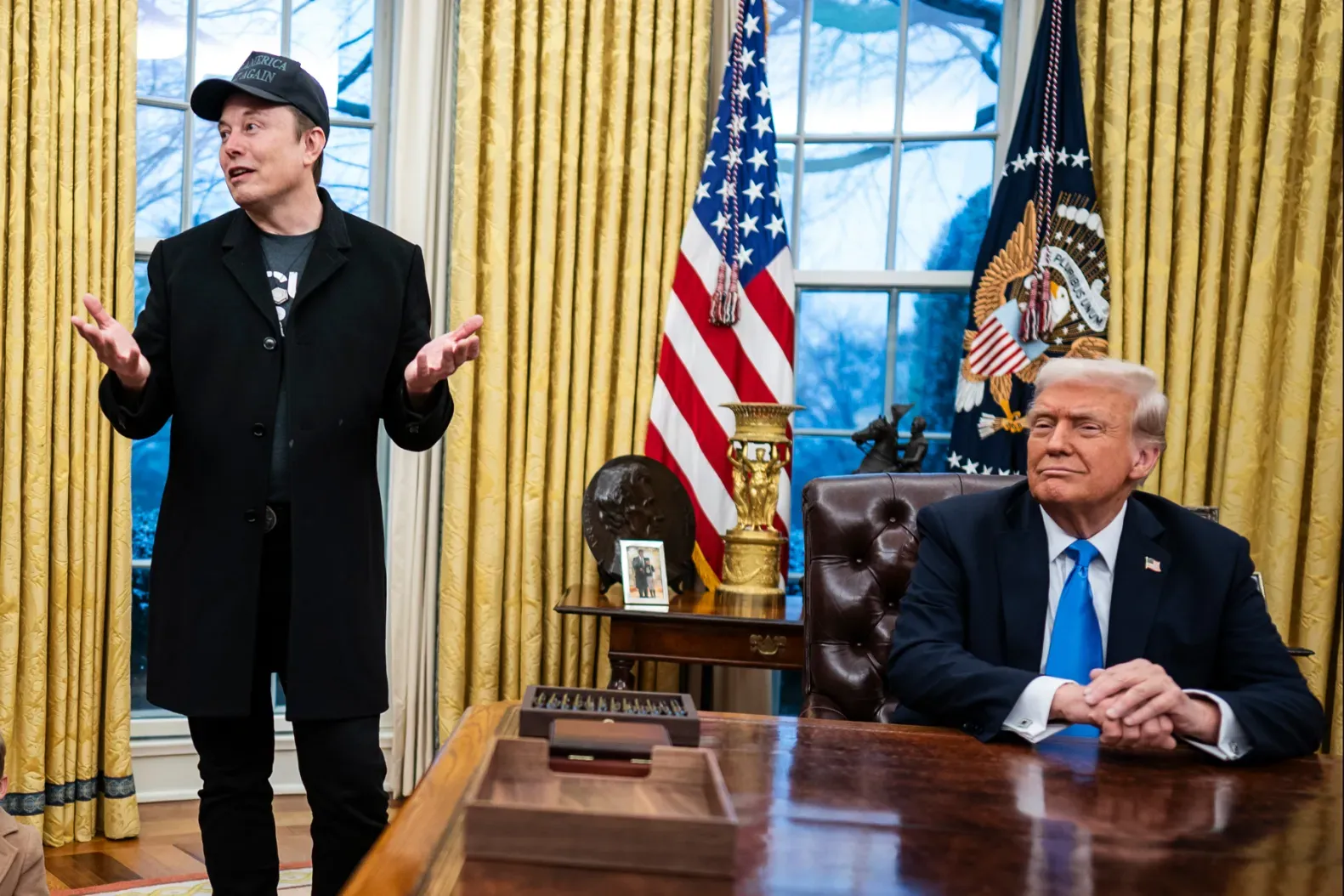
Elon Musk with President Donald Trump in the Oval Office at the White House on Feb. 11, 2025. | Jabin Botsford/The Washington Post/Getty Images
Agencies were cut.
Contracts were cancelled.
Workers were dismissed.
Programs were eliminated.
The public presentation was one of enormous savings. But something apparently contradictory happened at the same time: the national debt kept climbing.
And it eventually crossed $40 trillion.
That is because eliminating individual programs, even billions of dollars worth, is not remotely the same thing as repairing the underlying federal budget.
The country's fiscal problem is measured in trillions.
CBO currently projects a $1.9 trillion deficit just this year.
And the 2025 reconciliation law moved the long-term numbers in the opposite direction from fiscal consolidation.
CBO estimated that the 2025 reconciliation law would increase deficits by roughly $4.2 trillion over 2025-2034, including additional interest and economic effects. At the time, higher tariff revenue was expected to offset part of Washington’s broader fiscal deterioration. But that cushion proved much less durable: after the Supreme Court struck down the administration’s IEEPA tariffs in February 2026, CBO estimated their termination would add another $2 trillion to projected deficits over 2026-2036. The government has also begun refunding some tariff payments already collected.
By then, however, much of the damage had already been passed through the economy: businesses had absorbed higher input costs, consumers had paid higher prices, trade had been disrupted and long-standing commercial relationships had been strained.
Removing the tariff did not magically reset those prices, but it did remove part of the revenue Washington had been counting on.
This is the problem with focusing on highly visible individual government expenses.
Washington can cancel a $50 million program.
Or a $500 million program.
Or even tens of billions of dollars worth of programs, including lifesaving ones.
But simultaneously changing tax policy, entitlement spending, defense spending or interest costs can move the fiscal balance by trillions.
The scale is completely different.
What is actually driving the debt now?
Strip away the partisan arguments and several enormous forces remain.
Social Security
America is aging.
There are more retirees collecting benefits relative to the number of workers supporting the system.
Medicare and healthcare
The same demographic shift increases healthcare spending, while medical costs remain substantial.
A persistent gap between spending and revenue
Federal spending is projected at approximately 23.3% of GDP in 2026.
Federal revenues are approximately 17.5%.
That is an enormous structural difference even before another recession or emergency arrives.
Interest
Interest is now one of the fastest growing major components of the federal budget.
And increasingly: war
This part matters far beyond the direct appropriations Congress makes for military operations.
Because war has a second balance sheet: the inventory.
America is financing wars twice
A missile fired today has already been purchased.
So at first glance, firing it doesn't appear to increase the national debt.
But now the United States has one fewer missile.
If Washington wants to restore the military to its previous level of readiness, it eventually has to purchase another one.
That replacement becomes a future federal expense.
And the scale of that obligation is becoming impossible to ignore.
The U.S. conflict with Iran has heavily depleted several categories of precision weapons and air defense interceptors.
CSIS concluded this summer that the Iran campaign had depleted inventories of weapons that would also be critical in a potential Western Pacific conflict.
Rebuilding some categories, including Tomahawks, Patriots and THAAD interceptors, could take years.
Reuters reported in August that the United States had used virtually all of some categories of long-range precision missiles during the Iran war, while Patriot, THAAD and Tomahawk inventories were also under considerable strain.
Washington is now responding with enormous multiyear procurement commitments.
The Navy recently awarded RTX a contract worth as much as $22.9 billion to dramatically increase Tomahawk production.
The Army awarded Lockheed Martin a Patriot missile production agreement worth up to $58.6 billion, stretching through 2032, while the company works to increase production capacity.
Those contracts can strengthen the American industrial base.
They create jobs.
They increase manufacturing capacity.
They may eventually reduce unit costs.
And they can support exports.
But they also illustrate an important reality:
Using existing weapons today creates a replacement bill tomorrow.
And if federal revenue does not cover that bill, some of it becomes additional borrowing.
Then there is the arms-sales paradox
The United States is the world's dominant arms supplier.
Foreign demand for American aircraft, missiles, air defenses and other systems supports U.S. manufacturing, employment and strategic relationships.
But we need to be precise about the economics.
Foreign Military Sales are not designed as a profit center for the U.S. Treasury.
Under the FMS system, foreign customers generally cover the cost of the equipment and the government's administrative costs. DSCA describes the system as structured so the U.S. government neither makes a profit nor leaves the expense with the American taxpayer.
The economic benefit is different.
The money flows largely into the American defense industrial base.
It supports U.S. production lines:
Factories, workers, suppliers, research, and larger production runs that can help sustain capabilities the Pentagon itself needs.
Foreign sales can therefore help finance the industrial ecosystem on which U.S. military power depends.
But now consider what happens during prolonged American military operations.
The same Patriot interceptor may be wanted by: the U.S. military for its own defenses, an ally facing an immediate threat, and a foreign customer willing to buy it.
The factory cannot instantly produce three.
That turns a financial problem into a capacity problem.
Even if an ally has the money and Washington approves the sale, the weapon still has to exist.
So prolonged conflicts can produce a strange result: demand for American weapons rises enormously, American defense companies accumulate huge order books, yet Washington may simultaneously have to prioritize replenishing U.S. stockpiles over delivering scarce systems elsewhere.
Lockheed Martin's backlog has risen to more than $230 billion amid surging global demand, even as the Pentagon pushes contractors to expand production because American inventories themselves need replenishment.
In other words:
America can have customers it cannot immediately supply.
That matters economically, but it matters strategically even more.
Because U.S. arms sales are not simply exports, they are part of the alliance system.
Selling Patriots, F-35s, HIMARS or other American systems binds allies into U.S. training, maintenance, ammunition and logistics networks for decades.
If American production capacity cannot satisfy both U.S. wartime consumption and allied demand, Washington loses part of that strategic leverage.
And this is where debt and national security collide
The U.S. is currently spending money to fight, it is consuming equipment that must later be replaced, it is committing billions more to expand manufacturing capacity, and it is paying increasingly large amounts of interest on the money it already borrowed for previous priorities.
At the same time, many of the same weapons being consumed in the Middle East would matter in a completely different contingency.
China.
CSIS has specifically warned that several munitions heavily used against Iran would also be required in a Western Pacific conflict.
So the cost of one war isn't limited to what Treasury spends on that war.
There is an opportunity cost.
A Patriot interceptor fired in the Middle East cannot simultaneously protect a base in the Indo-Pacific.
A Tomahawk launched today isn't available for another theater tomorrow.
A production line focused on rebuilding American inventories has less immediate capacity for foreign customers.
And billions directed toward emergency replenishment are billions unavailable for some other federal priority unless Washington raises more revenue or borrows again.
That is the deeper danger of sustained deficits.
They progressively reduce choice.
Is $40 trillion itself the crisis?
Visualization of $40T in cash
Not necessarily.
A government is not a household.
The United States does not need to pay the entire national debt back one day like a mortgage.
Treasury securities constantly mature and are refinanced.
And because the United States controls the world's dominant reserve currency and one of the world's deepest and most liquid financial markets, it has enormous borrowing capacity.
The more important questions are:
How large is the debt relative to the economy?
How quickly is it growing?
How much does it cost to service?
How much revenue does Washington collect?
And will investors continue lending to the United States at acceptable rates?
Those indicators are becoming less comfortable.
CBO projects debt held by the public rising from approximately 101% of GDP in 2026 to 120% by 2036, above the previous record following World War II.
Over the following two decades, CBO's baseline takes it to roughly 175% of GDP.
The deficit is projected to increase from roughly $1.9 trillion this year to $3.1 trillion in 2036.
And importantly, CBO expects those deficits while unemployment remains below 5%.
In other words, these aren't projections built around another Great Depression.
They are deficits embedded in otherwise relatively normal economic conditions.
CBO puts it plainly: the current fiscal trajectory is not sustainable.
So what happens next?
There probably isn't a morning when America simply wakes up and discovers it has gone bankrupt.
The more plausible deterioration is gradual.
More federal revenue goes toward interest.
Treasury has to issue more debt.
Investors demand higher yields.
Higher rates make refinancing more expensive.
That produces even larger interest bills.
Private borrowers may face higher financing costs as government borrowing competes for capital.
And Washington has less room to respond when the next genuine emergency appears.
Another recession, pandemic, financial crisis.. another war.
Or a confrontation in the Pacific.
That is why $40 trillion matters.
Not because there is some magical line between $39.9 trillion and $40 trillion.
But because the United States has gone from using debt primarily as a tool to absorb extraordinary shocks to relying on borrowing during relatively ordinary times, while simultaneously entering a period of extraordinarily expensive military commitments.
In 1998, Washington was celebrating the disappearance of the annual deficit.
A few years later, officials were seriously modeling a future with almost no publicly held federal debt.
Today, Treasury owes more than $40 trillion in total federal debt.
The United States is fighting wars, rebuilding depleted weapons inventories, expanding its defense industrial base, selling weapons to allies, preparing for possible competition with China, funding an aging population, AND paying more than $1 trillion a year simply to service previous borrowing.
The question is no longer whether the United States can borrow another trillion dollars.
The question is what happens when an increasing share of America's economic and industrial power is required to pay for decisions already made.
Eventually the cost of debt isn't measured only in dollars.
It is measured in the choices you can no longer make.
Next Saturday in the Financial & Geopolitical Literacy Series: What would happen if the U.S. dollar lost its position at the center of the global financial system?
We’ll look at how such a shift could actually happen, what could replace the dollar, and what it would mean for U.S. borrowing, interest rates, inflation, American consumers, and Washington’s ability to finance its global power.
This series is made possible by readers who support ONEST.
Please consider contributing to the ONEST Newsroom Fund. Your support helps keep this series independent and allows us to keep these articles available to everyone, rather than putting them behind the ONEST+ paywall.
Olga Nesterova is a journalist and founder of ONEST Network, a reader-supported platform covering U.S. and global affairs. A former White House correspondent and UN diplomat, she focuses on international security and geopolitical strategy.