APRIL 15: Blockade Tightens, Talks Resume, Global Pressure Builds
Middle East tensions deepen as the U.S. tightens its Iran blockade, talks prepare to resume, and global economic pressure builds around the Strait of Hormuz.
“The global outlook has abruptly darkened following the outbreak of war in the Middle East.” — IMF Economic Outlook
KEY DEVELOPMENTS
The Middle East has entered a new phase — not defined by a ceasefire, but by control.
The United States has effectively imposed a maritime blockade on Iran, halting sea-based trade and placing the Strait of Hormuz at the center of both military pressure and economic disruption.
At the same time, diplomacy has not stopped. Talks between the United States and Iran are expected to resume within days, with Vice President JD Vance likely leading a second round of negotiations ahead of the current ceasefire deadline.
But the gap remains.
The core disagreements — Iran’s nuclear program and control over the Strait — have not narrowed. And while negotiations are being prepared, military operations continue across Lebanon and Gaza, testing the limits of any diplomatic framework.
NUMBERS TO WATCH
20% — Share of global oil supply tied to the Strait of Hormuz 80,000 — Barrels per day drop in global oil demand projected by the IEA 1,000+ — U.S. sanctions imposed since Trump’s NSPM-2 directive $1.7B — Cost of Canada’s temporary fuel tax suspension $100M — Revenue loss from Zambia’s fuel tax freeze $4.7B — Germany–Ukraine defense package
MIDDLE EAST: FROM CEASEFIRE TO BLOCKADE
The defining shift is now operational.
According to U.S. Central Command, American forces have moved beyond deterrence and into enforcement — blocking ships entering and leaving Iranian ports and effectively shutting down maritime trade.
U.S. naval and air forces remain positioned to intercept any vessels attempting to bypass the blockade.
This is not a symbolic measure.
It is a direct attempt to cut off Iran’s economic lifelines — and it is already reshaping global trade flows.
At the same time, uncertainty persists around the Strait of Hormuz itself. While not fully closed, access remains restricted and politically controlled, reinforcing its role as the central lever of the conflict.
Saudi Arabia is now pressing Washington to reverse course.
Arab officials warn that continued U.S. pressure could push Iran to escalate further — not only in the Strait, but across other critical shipping routes.
In other words: the blockade is not just pressure. It is a risk multiplier.
Despite the escalation, diplomacy is still moving forward.
President Donald Trump has signaled that peace talks could resume this week, with Vice President Vance expected to lead the U.S. delegation.
The U.S. position is increasingly defined by two non-negotiables:
removal of Iran’s enriched uranium from the country
implementation of verification mechanisms preventing nuclear capability
These are not incremental asks.
They go directly to sovereignty, security, and regime control.
At the same time, signals from Washington remain mixed.
Trump has described the war as “very close to over,” while simultaneously:
maintaining the blockade
preparing new sanctions
warning of escalation if terms are not met
He has also introduced a geopolitical dimension involving China.
After raising concerns about Chinese weapons transfers to Iran, Trump stated that President Xi Jinping had assured him this would not happen, framing the situation as a cooperative effort to stabilize the Strait.
“China is very happy that I am permanently opening the Strait of Hormuz… We are working together smartly, and very well!”
Whether that reflects actual alignment or political messaging remains unclear.
IRAN: PRESSURE, ADAPTATION, AND CAPABILITY
Iran is facing mounting economic and military pressure — but not passively.
A Chinese tanker under U.S. sanctions successfully transited the Strait after reversing course earlier, demonstrating that enforcement remains uneven and subject to challenge.
At the same time:
Iran has reportedly acquired a Chinese spy satellite, enhancing its ability to track U.S. military movements
the head of the International Atomic Energy Agency has warned that any agreement must include “very detailed” verification mechanisms
Internally, the economic impact is deepening.
The U.S. Treasury is preparing to resume sanctions waivers on Iranian oil while simultaneously targeting smuggling networks, including a multi-billion-dollar oil and gold financing system tied to Hezbollah and the IRGC.
Since Trump’s directive, more than 1,000 individuals, vessels, and aircraft have been sanctioned.
The strategy is clear: maximum pressure — not gradual containment.
LEBANON AND GAZA: PARALLEL WARS CONTINUE
While negotiations focus on Iran, the war continues elsewhere.
more than 2,000 people have been killed since early March
attacks on medical workers are raising humanitarian concerns
Direct talks between Israel and Lebanon — hosted by U.S. Secretary of State Marco Rubio — mark the first such engagement in decades.
Both sides described discussions as positive.
But the gaps remain substantial:
Lebanon conditions participation on a ceasefire
Hezbollah rejects negotiations outright
Israel continues military operations
In Gaza:
Israeli strikes continue despite an existing ceasefire framework
civilian casualties, including children and journalists, are ongoing
These are not side conflicts. They are part of the same unresolved system.
GLOBAL ECONOMY: ENERGY SHOCK TAKES HOLD
The economic impact of the war is no longer hypothetical.
The International Energy Agency now projects a decline in both global oil supply and demand in 2026, driven by sustained high prices.
This is already visible in behavior:
households reducing fuel consumption
industrial production slowing
airlines cutting flights
The International Monetary Fund has issued a stark warning:
The conflict could push the global economy toward recession if energy disruptions continue.
For regions far from the conflict, the impact is immediate.
Pacific Island nations — heavily dependent on imported fuel — are already facing rising costs, electricity instability, and growing economic insecurity.
Across Africa, Zambia has frozen fuel taxes at a cost of $100 million in lost revenue.
The war is now shaping economic reality far beyond its geographic boundaries.
GLOBAL ALIGNMENTS: REALIGNMENT UNDER PRESSURE
The conflict is accelerating geopolitical shifts.
In Europe:
Spain and 17 countries are calling for Lebanon to be included in de-escalation efforts
Italy has moved away from military cooperation with Israel
At the same time, tensions between the U.S. and European allies are becoming more explicit.
Italian Prime Minister Giorgia Meloni publicly criticized Trump’s rhetoric on nuclear conflict, highlighting a growing divide in tone and approach.
BEYOND THE REGION: SYSTEM-WIDE EFFECTS
The ripple effects extend globally.
In Asia:
China is strengthening ties with the UAE
India and China continue cautious normalization
Indonesia is deepening military cooperation with the U.S. while engaging Russia
In Africa:
Algeria is expanding energy exploration, with BP receiving a new prospecting authorization in the country’s eastern basin as producers across the broader energy space reposition amid war-driven supply disruptions — including QatarEnergy’s continued effort to rebuild and expand its international upstream portfolio.
Benin has completed a stable presidential transition.
Sudan’s humanitarian crisis is intensifying.
In Latin America:
U.S. sanctions on Venezuela’s financial sector have been lifted, signaling a shift toward economic re-engagement
Across all regions, the pattern is consistent:
countries are adjusting — economically, militarily, and politically — to a prolonged period of instability.
UNITED STATES: POLICY AND POWER
Domestically, policy developments continue alongside global engagement.
The United States is expanding its global health footprint, with the State Department and the Global Fund announcing plans to scale access to the HIV prevention drug lenacapavir — developed by Gilead Sciences — to three million people by 2028, up from a previously announced target of two million. Gilead has maintained active political engagement in Washington, including a $1 million contribution to the Trump–Vance inaugural committee, though the expansion itself builds on long-standing U.S.-backed HIV/AIDS programs that have historically received bipartisan support.
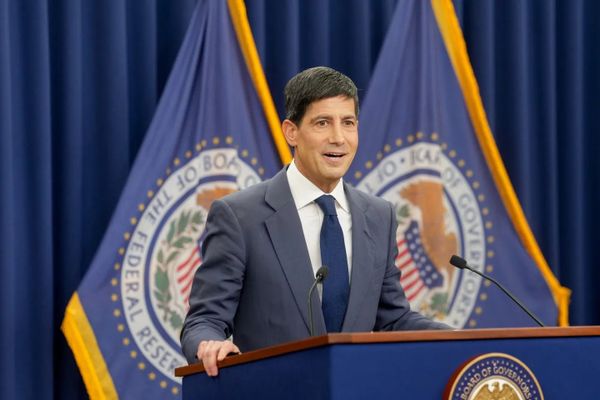
At the same time, federal scrutiny over domestic spending is intensifying — but not in isolation. The move comes as President Donald Trump has openly threatened to fire Federal Reserve Chair Jerome Powell unless he resigns, escalating tensions between the White House and the central bank.
Against that backdrop, prosecutors made an unannounced visit to the Federal Reserve’s headquarters construction site as part of an investigation into a $2.5 billion renovation project. While framed as oversight of infrastructure spending, the timing raises broader questions about political pressure on institutions designed to operate independently of the executive branch.
In the private sector, structural pressure is reshaping major industries. A U.S. jury found that Live Nation and its subsidiary Ticketmaster maintained a harmful monopoly over large concert venues, a ruling that could have far-reaching consequences for pricing, competition, and market structure across the live entertainment industry.
At the same time, U.S. military planning is accelerating in response to both immediate operational demands and longer-term competition.
The Air Force is seeking a 21 percent increase in its operations and maintenance budget for fiscal 2027, aimed in part at sustaining higher flight hours and readiness levels as deployments expand. In parallel, National Guard leaders from nearly two dozen states are urging Congress to approve multi-year funding for 72 to 100 new fighter jets annually, including platforms such as the F-35A Lightning II, F-22 Raptor, and F-15EX, as the U.S. moves to replace aging aircraft across its active and reserve forces.
At the same time, the military continues to rely heavily on unmanned systems — even as their vulnerability becomes more visible. The MQ-9 Reaper remains a central asset in current operations, including in the Iran conflict, but the U.S. has lost at least 35 Reaper drones in recent years, including multiple shootdowns over Iran and Yemen.
Taken together, these developments point to a force adapting in real time:
increasing funding to sustain current operations
accelerating modernization to prepare for future conflict
and continuing to rely on systems that are effective — but increasingly contested
This is not just expansion. It is adjustment under pressure.
ROYAL VISIT TO THE U.S.
Buckingham Palace announced that King Charles III and Queen Camilla will travel to the United States from April 27 to 30, with stops in Washington, New York, and Virginia. The visit will include a joint session of Congress address by the King and a private meeting with President Trump, as the two countries mark the 250th anniversary of U.S. independence.
Olga Nesterova is a journalist and founder of ONEST Network, a reader-supported platform covering U.S. and global affairs. A former White House correspondent and UN diplomat, she focuses on international security and geopolitical strategy.