The Mission Keeping the International Space Station Running
NASA’s CRS-24 mission will launch a Cygnus cargo spacecraft to the International Space Station carrying science experiments, supplies, and new research.

– 3 min read

NASA’s CRS-24 mission will launch a Cygnus cargo spacecraft to the International Space Station carrying science experiments, supplies, and new research.
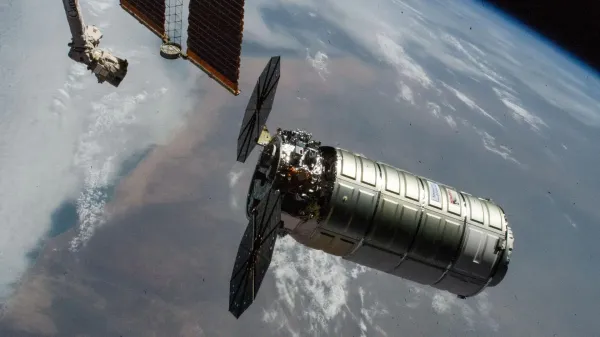
In early April, a cargo spacecraft will launch from Florida carrying science experiments, equipment, and supplies to the International Space Station, humanity’s permanently inhabited laboratory in orbit.
The mission — known as Northrop Grumman CRS-24 mission to the International Space Station — will send a Cygnus spacecraft built by Northrop Grumman into orbit aboard a SpaceX Falcon 9 rocket operated by SpaceX. The launch will take place from Cape Canaveral Space Force Station in Florida.
While resupply launches rarely receive the attention of human spaceflight missions, they are among the most important operations sustaining the station and the scientific work taking place there.
Cargo flights like CRS-24 deliver the materials that make research in orbit possible.
The Cygnus spacecraft will carry food, supplies, and new scientific experiments for astronauts living aboard the ISS. Once the spacecraft reaches orbit, astronauts will use the station’s robotic arm — Canadarm2 — to capture Cygnus and attach it to the station’s Unity module, where crews will begin unloading its cargo.
The spacecraft will remain attached to the station for several months before departing later in the year.
Resupply missions also serve another critical function: they enable the continuous cycle of experiments that the station hosts. Without regular cargo flights, the ISS would simply not be able to operate as a research platform.
Each ISS cargo mission carries a mix of experiments spanning multiple scientific fields.
This mission includes research aimed at advancing quantum science, which could improve future computing technologies and help scientists better understand fundamental physics questions such as dark matter.
Other investigations focus on biotechnology and medicine. Hardware on this mission will help researchers produce larger numbers of therapeutic stem cells, which could contribute to future treatments for blood diseases and cancer.
The spacecraft will also carry biological research examining the human gut microbiome using model organisms in microgravity. Understanding how microorganisms behave in space can help scientists better understand human health both in orbit and on Earth.
Another instrument onboard will study space weather, collecting data that may improve models used to protect satellites and critical infrastructure such as navigation and radar systems.
The ISS remains one of the largest international scientific collaborations ever built.
The station is operated by a partnership that includes the National Aeronautics and Space Administration, European Space Agency, Japan Aerospace Exploration Agency, Canadian Space Agency, and Roscosmos.
For more than 25 years, astronauts and cosmonauts from these partner nations have lived and worked continuously aboard the station. Their research spans biology, physics, Earth science, and technology development — often taking advantage of the microgravity environment to conduct experiments impossible on Earth.
This international cooperation has allowed the ISS to become not only a scientific platform but also a model of long-term collaboration in space.
Resupply missions like CRS-24 also illustrate a major shift in how space operations are organized.
Instead of building and operating every spacecraft itself, NASA increasingly contracts private companies to deliver cargo and transportation services. Through its Commercial Resupply Services program, companies such as Northrop Grumman and SpaceX provide the launch systems and spacecraft that keep the station supplied.
This approach has helped create a growing commercial space industry in the United States, with private companies now responsible for launching cargo, astronauts, and eventually building new space stations.
At the same time, NASA is focusing its resources on deep-space exploration — including missions to the Moon through the Artemis program, which aims to establish a sustainable human presence beyond Earth and eventually prepare for future missions to Mars.
Human spaceflight often captures headlines, but cargo missions are what make long-duration operations in orbit possible.
Every resupply launch brings the tools, experiments, and supplies that keep the station functioning — and enable the research that continues to expand scientific knowledge.
As humanity prepares to return to the Moon and eventually travel farther into the solar system, these routine cargo flights remain the quiet backbone supporting life and science in orbit.