Three Winter Escapes in France
- Rachel Thomas-Bonnet

- Nov 30, 2025
- 4 min read
...Worth Crumpling Yourself into Economy for




By Rachel Thomas-Bonnet
If you live in the US, winter can start to feel like an endurance sport: de-icing the car, pretending you like pumpkin spice, and watching yet another “holiday sale ends tonight!” email roll in.
Alternative plan: come to France, where winter can mean fairy-lights, sunshine or castles and cassoulet — and where your main problem is whether you've ordered quite enough cheese.
Here are three very different French winter escapes that are absolutely worth crossing the Atlantic for.
Strasbourg — Christmas Turned Up to Eleven

If you've ever looked at those “European Christmas market” photos and thought, “Oh, come on, nobody's town actually looks like that” — that's Strasbourg. It's annoyingly real and absolutely freezing, in the best possible way.
The historic centre turns into a glowing film set: half-timbered houses, angels and stars strung over the streets, the cathedral looming over the whole thing like it's supervising. The Christmas market dates back to the 1500s, so they've had time to practise. Wooden chalets are crammed into every square, selling vin chaud, gingerbread, sausages, pretzels and kougelhopf — a yeasted cake that will not help your New Year resolutions one bit.
Last time I went, I swore I wouldn't buy more Christmas decorations.
Reader, I lied.
Why you might actually get on the plane
• It's small enough that you can walk everywhere once you're there.
• Easy route from the US: fly into Paris or Frankfurt and hop on a high-speed train.
• It's French and German at the same time — architecture, food, and that little lilt in the accent.
Rachel tip: Give yourself one market-free afternoon. Find a cosy winstub (local wine tavern), order something involving melted cheese, and just watch people trying to walk gracefully on cobbles wearing too many layers.
Strasbourg is a perfect example of how France is really a collection of mini-countries. That's very much the spirit of Escape the Crazy, my slightly irreverent guide for people who are toying with the idea of actually moving here.
Nice — Winter Sun on the Riviera (Smugness Included)

Before Instagram discovered it in a bikini, Nice was a winter resort. The British and Russians used to come down for the light and the sea air while their home cities froze solid. Sensible people.
In January, you can stroll along the Promenade des Anglais with palm trees on one side and ridiculous blue sea on the other. It's not beach-towel hot, but when you've just left a New York sleet storm, 55°F and blue sky feels extremely civilised. Terraces are open, the old town is bustling but not frantic, and you can actually get a restaurant table without a small war.
I have, in fact, sat on that promenade in January, coat open, texting smug seaside photos to freezing friends. It was very therapeutic. For me.
Sunny reasons to bother with the long flight
• Fewer crowds, better prices, and you can actually see the pavements.
• Quick train hops to Antibes, Villefranche and Menton if you fancy playing at being a Riviera local.
• Time it for February and you get Carnival in Nice plus the Lemon Festival in Menton — giant citrus sculptures, because why not.
Rachel tip: Pack layers. You'll see one person in flip-flops and another in full ski gear on the same bench. Both will insist the other one is mad.
One of the big themes in Escape the Crazy is: choose your climate as carefully as you choose your house. A winter week in Nice is basically a very pleasant “research trip.”
Carcassonne & the Quiet South — Castles, Wine and Real Life

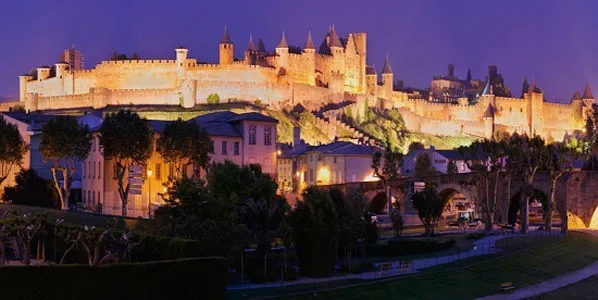
If your inner twelve-year-old still secretly wants a castle, Carcassonne will make them very happy. The medieval cité sits on a hill, wrapped in double walls and bristling with towers, looking exactly like the opening shot of a fantasy series.
In summer, it can feel a bit theme-parky. In winter, with the wind whipping round the ramparts and the mist hanging over the valley, it suddenly becomes a fortress again. You crunch over the cobbles, duck into the basilica to defrost, and then go in search of cassoulet — the local slow-cooked beans, duck and sausage combination that doubles as central heating.
Full disclosure: this is my part of the world, so I am gloriously biased.
The real charm is just beyond the walls. The surrounding Minervois and Corbières wine regions are full of villages where real life happens all year round: markets, vineyards, village cafés where everyone knows whose dog escaped this time. This is the France people move to when they say, “We wanted a quieter life” — often forgetting to mention the excellent wine.
Why it's worth the detour (and possibly the relocation fantasy)
Instead of bullets, let's be honest: Carcassonne works because you get the full castle-on-a-hill drama and a peek at what everyday life looks like in the south. It's easy to reach (there's a tiny airport, and Toulouse/Béziers is about an hour away), property is still more affordable than on the Riviera, and it's the sort of area where “popping out for bread” somehow also involves chatting to three neighbours and buying a bottle of local wine you didn't know you needed.
Rachel tip: Walk the ramparts in the morning. Spend the afternoon in a village café listening to locals grumble about the weather and the price of petrol. That's where you really find out if this quieter, slower France is your kind of madness.
This corner of Occitanie is classic Escape the Crazy territory: beautiful, slightly under the radar, and full of the everyday stories you never see in glossy brochures.
If you're currently staring at a salted, slushy American street and wondering whether winter has to be like this every year... it doesn't.
It can be fairy-lights in Alsace, sunshine on the Riviera, or a glass of Minervois by the fire in the south of France.
Your call.
Watch Rachel’s NO POLITICS episode
She talks about:
• what inspired her book
• how people reacted to it in NYC
• what it means to “flee the stupid”
• her advice on starting over with clarity and courage


Comments