Canada–Qatar: “Strategic Partnership” — or Strategic Messaging?
- Olga Nesterova

- 3 days ago
- 4 min read
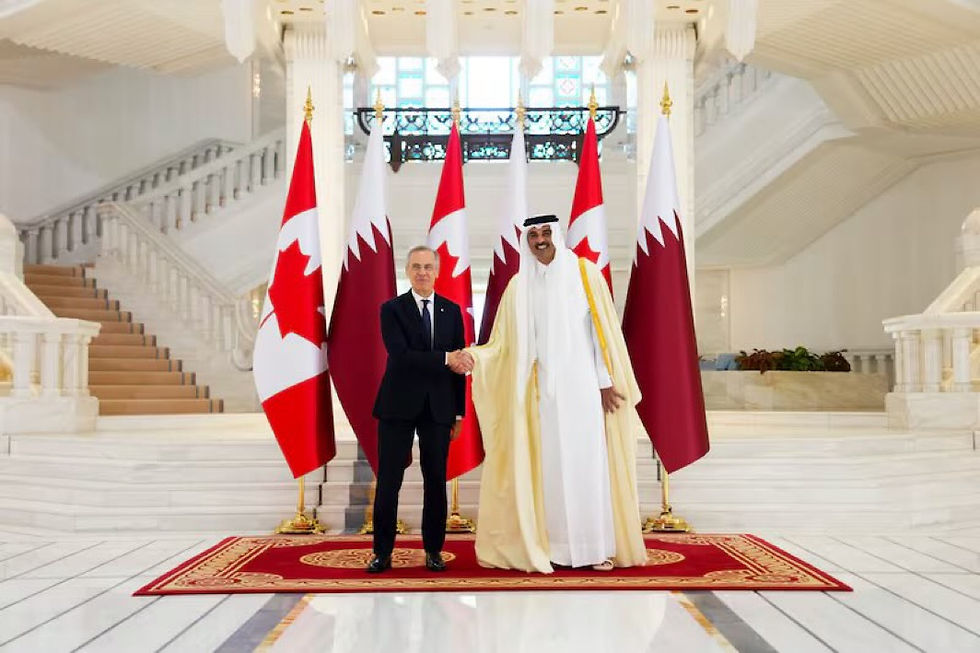
On January 18, 2026, Prime Minister Mark Carney became the first sitting Canadian prime minister to visit Qatar, positioning the trip as part of Canada’s push to diversify trade, investment, and security partnerships amid a more volatile global landscape.
The headline promise is big — Qatar will make “significant strategic investments” in Canada’s nation-building projects — and the list of cooperation areas is expansive: AI, quantum, aerospace, defense tech, advanced manufacturing, agriculture, and more.
But when you separate what’s signed, what’s promised, and what’s simply “we intend to”, the picture becomes clearer — and more complicated.
What’s real vs. what’s vibes
What appears to be signed now (tangible, but mostly “framework”)
The visit produced signed instruments — not a trade treaty, but institutional scaffolding:
A memorandum establishing a Joint Canada–Qatar Economic Commission for economic, commercial, and technical cooperation
A memorandum on Information Technology cooperation, explicitly tied to AI and emerging technologies
A Letter of Intent on FIFA World Cup 2026 security cooperation, leveraging Qatar’s 2022 experience
These are real documents, but they are not market-access deals. They create working groups, dialogue channels, and cooperation pipelines — useful, but not enforceable economic outcomes.
What’s promised, but not priced or specified
The most attention-grabbing claim — Qatar’s commitment to make “significant strategic investments” in Canadian nation-building projects — is non-quantified and project-unspecified in all official language released so far.
That does not mean it is empty. It means the public cannot yet verify:
how much capital is involved
which projects will receive it
whether investments are equity, debt, or blended finance
what governance or control rights may accompany the capital
what timelines apply
In short: a political commitment exists; a contract does not — yet.
What’s agreed to negotiate, not yet in force
Several core elements of the partnership remain explicitly aspirational:
A Canada–Qatar Foreign Investment Promotion and Protection Agreement (FIPA), with a goal to conclude negotiations by summer 2026
A Double Taxation Agreement, with negotiations to begin
A broader defense and security framework, described as negotiations to facilitate exchanges of expertise
These could become consequential — especially a FIPA — but until they are signed, ratified, and implemented, they remain directional.
The quiet strategy underneath: Canada is building optionality
This Qatar visit fits into a wider pattern: Canada is moving quickly to reduce reliance on any single economic partner by expanding capital and security relationships elsewhere.
Qatar offers three things Canada wants simultaneously:
sovereign capital with long investment horizons
defense and security cooperation capacity
diplomatic reach disproportionate to its size
The partnership is less about immediate trade volumes — which remain modest — and more about positioning Canada inside emerging global capital and security networks.
Why Qatar wants Canada
This relationship is not altruistic.
Qatar is actively positioning itself as a global investment, mediation, and influence hub. Canada offers:
a stable G7 destination for sovereign wealth
access to North American AI, aerospace, and advanced manufacturing ecosystems
reputational reinforcement through partnership with a democratic middle power
The relationship aligns directly with Qatar’s long-term diversification and global positioning strategy.
Why Canada wants Qatar
Canada’s stated rationale is diversification: capital, markets, and security partnerships that reduce vulnerability to global shocks.
Several enabling moves were already in place before the visit:
visa-free (eTA-based) travel for Qatari citizens
expanded air services between the two countries
growing institutional familiarity through past diplomatic and consular cooperation
The Doha visit accelerates a trajectory that was already quietly underway.
Global implications: what this signals beyond Ottawa and Doha
1. Gulf partnerships are no longer exceptional
Canada is treating the Gulf not just as an energy region, but as a capital-, security-, and technology-partner region — a structural shift in foreign economic policy.
2. Qatar becomes part of Canada’s diplomatic toolkit
The partnership explicitly frames Qatar as a stabilizing diplomatic actor, from Ukraine to the Middle East. That offers leverage — but also ties Canada more closely to Qatar’s balancing acts.
3. AI, defense, and sovereign capital are now linked
The repeated bundling of AI, defense technologies, and investment signals where the relationship could become strategically sensitive, particularly around governance, data, and export controls.
The questions that will decide whether this is substance or branding
If this partnership is to move beyond optics, several things will need clarity:
A) What are the actual “nation-building projects”?
Names, amounts, structures, and oversight matter. Without them, the investment promise remains rhetorical.
B) What guardrails apply to strategic assets?
If Qatari capital enters infrastructure, energy, defense supply chains, or data-heavy sectors, transparency on control and influence becomes essential.
C) What does the FIPA lock in — and constrain?
Investment protection agreements can attract capital, but they can also limit domestic policy space depending on design. The fine print will matter more than the headline.
D) How far does defense cooperation go?
From defense attaché offices to training and intelligence exchange, scope and oversight will determine whether this remains routine or becomes politically sensitive.
E) World Cup 2026 security cooperation
Operationally practical — but security cooperation always involves data, systems, and institutional trust. Canadians will want to know where the lines are.
Bottom line
This Canada–Qatar “strategic partnership” is real in direction and mechanisms — memoranda, commissions, letters of intent — but unproven at its center until promised investments are specified and negotiated agreements move from intention to implementation.
What to watch next
Named investment announcements with amounts, projects, and structures
Draft text and parliamentary handling of a Canada–Qatar FIPA
Launch and scope of double-taxation negotiations
Concrete air-service expansions (routes, frequencies, carriers)
Implementation details of World Cup 2026 security cooperation


Comments