From the JCPOA to Geneva: Why “Zero Enrichment Forever” Is Not a Negotiation — and Why China Is Watching
US-Iran Geneva talks escalate as Washington demands permanent zero enrichment and Iran refuses. Analysis of the JCPOA history, Trump’s second-term strategy, Israel’s strike debate, China’s Taiwan calculus, and why this isn’t “Venezuela.”
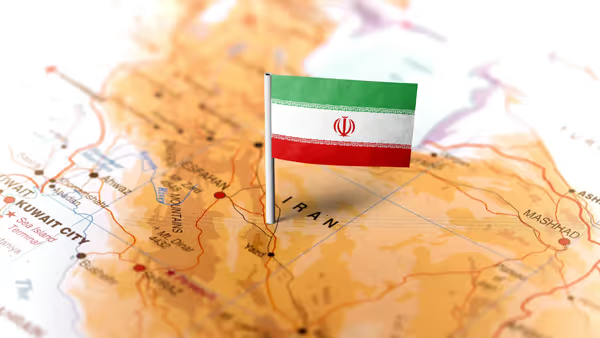
The modern Iran nuclear framework begins with the JCPOA (2015): a bargain built on limits, inspections, and phased sanctions relief — not total dismantlement. Iran kept limited enrichment under tight caps and monitoring, and the deal included time-bound provisions.
In 2018, President Trump withdrew the United States from the agreement and reimposed sweeping sanctions under “maximum pressure,” arguing the JCPOA’s sunsets and scope were unacceptable. The result was a slow collapse of the framework and a return to escalation logic: sanctions, sabotage, proxy pressure, and rising enrichment.
How we got here
Fast forward to now: the negotiating baseline has shifted. Iran’s program, regional tensions, and military posture are all fundamentally different than 2015 — and U.S.–China competition now sits over everything like a second sky.
That is the context for today’s round.
How many meetings in Trump’s second term
This week’s Geneva session is being treated publicly as a key moment, but it is not the first contact. Reporting describes this as the third round of indirect nuclear talks, with technical discussions expected to continue in Vienna.
Today: Witkoff and Kushner in Geneva
Today’s Geneva talks included U.S. envoys Steve Witkoff and Jared Kushner engaging Iranian representatives, with the process described as indirect but involving consultations and structured follow-on work.
And the reporting on what was presented is the clearest signal yet that we are no longer in “JCPOA territory.”
The Geneva documents: two positions that don’t overlap
What the Wall Street Journal reporting says the U.S. demanded in Geneva:
Destroy Fordow, Natanz, Isfahan
Transfer enriched uranium out of Iran
Permanent zero enrichment on Iranian soil
No sunsets / no expiration
Limited upfront sanctions relief, more only after sustained compliance
Iran’s reported counter-position:
A 3–5 year suspension of enrichment
Expanded IAEA oversight
Willingness to dilute stockpiles
No agreement to permanent zero enrichment
This is not a technical argument about centrifuge models. It is a structural argument about whether Iran is permitted any enrichment capacity at all — permanently.
The political sequencing problem
One of the most revealing lines to surface this week: reporting that senior Trump advisers privately prefer Israel strike first because “the politics are a lot better” if the U.S. enters after Iranian retaliation.
That is not a doctrine. It is a liability design:
Israel hits → Iran retaliates → U.S. enters as responder.
And here’s the destabilizer: if both allies want the other to go first, hesitation becomes a trigger risk all its own.
China’s role: not just watching — shaping the environment
Let’s separate what is confirmed from what is strategically meaningful even if partly performative.
1) Verified: China–Iran missile channel is tightening
Reuters reports Iran is nearing a significant deal to acquire Chinese CM-302 supersonic anti-ship missiles, which would improve Iran’s ability to threaten naval assets in the Gulf — exactly the pressure point that matters when U.S. carriers are forward.
That is not symbolism. That is capability.
2) Verified: U.S. is now dispersing elite airpower into Israel
WSJ and AP report the U.S. has deployed F-22s to Israel’s Ovda air base amid the standoff — a notable deepening of posture and a message of readiness.
3) OSINT / information warfare: the “annotated imagery” effect
Online posts claim Chinese-language annotated satellite imagery tagged the F-22s at Ovda and circulated on Chinese platforms. The specific “menu-style” annotations are not yet independently verified by major outlets — but the phenomenon matters regardless: open-source exposure is now part of the battlespace, because it degrades operational ambiguity and normalizes real-time mapping of deployments.
China does not need to fire a shot for this to be useful. It just needs to:
observe deployments,
measure response cycles,
amplify visibility,
and watch how the U.S. allocates finite resources.
ONEST take: Heavy U.S. involvement against Iran widens China’s Taiwan window
This is the core strategic tension:
A sustained Iran campaign consumes precision munitions, interceptors, airframe readiness, tanker demand, ISR bandwidth, and political oxygen that are also central to a Taiwan contingency. The “empty bins” problem is not theoretical; it is a recurring conclusion in U.S. defense-industrial analysis and war-gaming.
Meanwhile, the U.S. itself is already working overtime to accelerate certain Taiwan-relevant deliveries (like F-16Vs) amid delays — a reminder that replenishment is not instantaneous.
So Beijing’s incentive structure is clean:
Let Washington get pulled into a munition-intensive regional war.
Track depletion and production throughput.
Learn which systems are “scarce” in practice, not just on paper.
Then decide what risk calculus looks like in the Taiwan Strait.
China may be running a live stress test: not “Iran vs U.S.” but U.S. bandwidth under multi-theater strain.
“Trump wants this to be like Venezuela.”
Why Iran is not Venezuela.
There’s a reason the Venezuela comparison keeps appearing in this moment: the Maduro capture created a political template — a story of decisive action, a clean outcome, and an immediate optics win. Reuters reporting on the Venezuela operation underscores how unusual and dramatic that episode was.
But multiple reports around this Iran deliberation describe officials warning that Iran is not a Venezuela-style operation — because the costs, retaliation, and time horizon are fundamentally different.
Now the case study — in ONEST terms:
1) Geography and depth: Iran is built for endurance, not extraction
Venezuela was an extraction-style operation against leadership.Iran is a hardened state with layered security services, dispersed infrastructure, and strategic depth.
Even the nuclear facilities at the center of this story were built with survivability in mind — and any air campaign becomes a multi-day or multi-week problem, not a single-night problem. Reuters has reported U.S. planning scenarios that anticipate potentially weeks-long operations — not a quick strike.
2) Retaliation: Iran’s response toolbox is larger — and closer to U.S. forces
Iran has the region’s largest missile/drone stockpiles by multiple assessments, and analysts warn Iran would likely respond more forcefully in a renewed conflict environment.
U.S. posture in the Gulf is not insulated; it is exposed — and Bahrain’s shift to “mission critical” staffing underscores that Washington anticipates risk to its footprint.
3) Proxies: Venezuela had partners; Iran has a network
Iran’s proxy ecosystem (Hezbollah, Houthis, aligned militias in Iraq/Syria and others) is a mechanism for distributing conflict across fronts — including against U.S. forces and interests. That is precisely what makes escalation unpredictable: the battlefield is not one country.
And crucially: proxies don’t need to “win.” They just need to keep conflict alive in enough places long enough to change U.S. political math.
4) Global economic leverage: Hormuz is not Caracas
Iran sits adjacent to the Strait of Hormuz — and the energy market is already pricing risk. Reuters reports tanker rates spiking amid fears of disruption, noting the Strait handles roughly 30% of global seaborne oil exports. EIA and IEA data show the Strait is a critical global chokepoint by volume and share of trade.
Venezuela mattered for oil politics.Hormuz can shock the global economy.
5) The U.S. homeland is in the proxy map
This is the part that gets understated: Iran’s network and capability set includes external operations, cyber capacity, and long-distance asymmetric pressure. Even without “direct hits,” the threat environment for U.S. interests expands — from bases to shipping to infrastructure to global targets.
That is why “like Venezuela” is not just a bad analogy. It is a dangerous one.
Where this leaves Geneva
Geneva is not “the place peace happens.” It is the place the record gets written.
The reporting suggests the U.S. put forward terms that require permanent surrender of enrichment and destruction of core facilities. Iran is offering temporary suspension and monitoring — while refusing permanent zero enrichment.
If neither side moves off those absolutes, the talks are not bridging a gap — they are documenting one.
And while that documentation happens, China is learning in real time what U.S. multi-theater stress looks like — and whether America is willing to spend tomorrow’s Indo-Pacific readiness on today’s Middle East escalation.
Olga Nesterova is a journalist and founder of ONEST Network, a reader-supported platform covering U.S. and global affairs. A former White House correspondent and UN diplomat, she focuses on international security and geopolitical strategy.