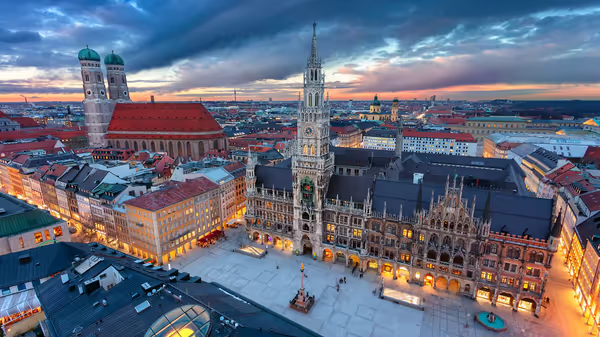
The Munich Security Conference 2026 report (February 2026) sets the tone before a single leader takes the stage.
Its title — Under Destruction — is not rhetorical. It signals something deeper than geopolitical turbulence. It suggests that the frameworks designed to stabilize the international system are not merely stressed — they are being actively eroded.
The Return of Power Politics
The report describes a world increasingly defined by hard power calculations rather than shared rules.
Great powers:
- Fear dependency.
- Weaponize dependency.
- Prioritize leverage over legitimacy.
This framing was echoed almost verbatim by Germany’s Chancellor Friedrich Merz in his opening remarks:
“Big power politics has its own rules. It is fast, harsh & unpredictable. It fears own dependencies, but uses and exploits dependencies of others. This is a dangerous game. At first for small players, but later on also for big players.”
This alignment between the report and the opening speech is telling.
The destruction the report refers to is not physical — it is structural:
- Trust
- Multilateral coordination
- Trade interdependence
- Security guarantees
The foundations of post–Cold War stability are now treated as negotiable instruments.
Strategic Fatigue vs Strategic Endurance
One recurring theme in the report is exhaustion.
Conflicts are prolonged. Alliances are tested. Societies are divided internally.
President Zelenskyy articulated this danger clearly in Munich:
“My biggest fear is world fatigue. If the partners lose interest, if they decide that this is a ‘distant war,’ it will be dangerous. Russia is playing for exhaustion. We are playing for principle.”
The MSC report identifies this as a defining strategic risk: The erosion of attention.
Modern geopolitics is increasingly shaped not only by battlefield dynamics — but by narrative stamina.
Institutional Erosion
The report warns of weakening confidence in:
- International law
- Multilateral institutions
- Collective security mechanisms
This tension surfaced directly in Zelenskyy’s remarks:
“I do not trust Putin. And no one should. Therefore, everything must be fixed by international mechanisms. Control, verification, specific steps.”
Even amid skepticism, the call is not for abandonment of institutions — but reinforcement.
That paradox defines Munich 2026: Institutions are criticized, pressured, and yet relied upon.
Europe’s Strategic Question
President Emmanuel Macron framed it bluntly:
“No peace without the Europeans. You can negotiate without the Europeans, but it will not bring peace at the table.”
He went further:
“We have to be the one to negotiate new architecture of security for Europe the day after, because our geography will not change.”
The MSC report similarly underscores that Europe must clarify its strategic agency.
The core question: Will Europe remain reactive — or define its own postwar security architecture?
The China Variable
The report treats China not only as a competitor, but as a decisive variable in global stability.
Germany’s Foreign Minister Wadephul said:
“Face-to-face dialogue with China is key… We have strong economic ties. We need open markets and free trade. Competition must be fair and based on rules.”
Simultaneously:
“Russia's war of aggression against Ukraine and its support by third parties jeopardize European security. We expect China to use its influence to ensure a lasting peace for Ukraine.”
China is positioned not merely as observer — but as leverage holder.
The System Is Not Collapsing — It Is Being Rewritten
The report does not conclude that multilateralism is dead.
It concludes it is contested.
This is not the end of institutions. It is the struggle over their evolution.
Munich 2026 is less about speeches —and more about whether the architecture of security survives its current stress test.