APRIL 10: Talks Ahead, Strait Still Closed, Ceasefire Tested

“If the Iranians are willing to negotiate in good faith, we're certainly willing to extend the open hand. If they're going to try to play us, then they're going to find that the negotiating team is not that receptive.” — JD Vance
KEY DEVELOPMENTS
A fragile ceasefire has brought the United States and Iran to the edge of direct negotiations — but not to stability.
This weekend’s talks in Pakistan are being framed as decisive. The outcome will not only shape the trajectory of the war, but also determine whether the global energy system begins to stabilize — or remains under sustained shock.
At the center of it all remains the Strait of Hormuz.
Despite agreements, statements, and pressure from multiple sides, the Strait is still largely closed. Very few ships are passing — and those that do, do so under conditions set by Iran.
At the same time, military activity continues across the region, particularly in Lebanon, where Israeli strikes risk collapsing the very framework that enabled these talks to happen.
NUMBERS TO WATCH
20% — Share of global oil supply that passes through the Strait of Hormuz
1 — Day until U.S.–Iran talks begin in Pakistan
3+ — Dozen schools and healthcare facilities damaged in Iran
$950M — Oil market bet placed ahead of ceasefire announcement
10 — Days of Artemis II mission, now successfully completed
US–IRAN: TALKS ON THE EDGE OF FAILURE OR BREAKTHROUGH
The next phase of this conflict is no longer being shaped primarily on the battlefield.
It is being shaped at the negotiating table — or more precisely, in the narrow space between negotiation and escalation.
This weekend, U.S. and Iranian delegations will meet in Islamabad for what increasingly looks like make-or-break talks.
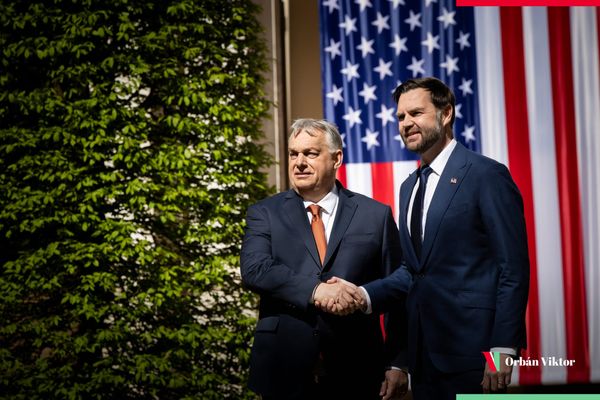
The U.S. delegation will be led by Vice President JD Vance, joined by envoy Steve Witkoff and Jared Kushner. On the Iranian side, Foreign Minister Seyed Abbas Araghchi and the Speaker of Parliament are expected to lead discussions.
The tone ahead of the talks reflects both openness and warning.
Vance made clear that the United States is willing to engage — but not without limits:
“If the Iranians are willing to negotiate in good faith, we're certainly willing to extend the open hand. If they're going to try to play us, then they're going to find that the negotiating team is not that receptive.”
President Donald Trump has struck a more optimistic tone publicly, saying he is “very optimistic” about a long-term agreement and describing Iranian negotiators as more reasonable in private than in public.
At the same time, that optimism is paired with continued pressure.
Trump has made clear that:
- U.S. military assets will remain in the region until a deal is reached
- escalation remains on the table if negotiations fail
- Iran is being accused of violating ceasefire terms by restricting oil flows
This is the central dynamic heading into talks:
engagement under pressure — not de-escalation before agreement.
STRAIT OF HORMUZ: STILL CLOSED, STILL THE LEVER
Despite the ceasefire framework, the Strait remains the defining factor.
Very few ships are passing.
The global energy system is still operating under constraint.
And the political signaling around the Strait has intensified.
Trump has accused Iran of restricting passage and warned against imposing tolls.
At the same time, Iranian messaging has shifted toward signaling capability rather than immediate action.
Semiofficial Iranian outlets published imagery suggesting that the Revolutionary Guard deployed sea mines into the Strait, a move widely interpreted as a signal: the capability to fully shut down the waterway remains in place.
This is not simply about passage.
It is about leverage.
Who controls the Strait controls the pace — and pressure — of negotiations.
THE CEASEFIRE: HOLDING ON PAPER, TESTED IN PRACTICE
The ceasefire that enabled these talks remains fragile.
Israeli operations in Lebanon continue to strain its foundations.
There is still no agreement on whether Lebanon is included in the truce:
- The United States maintains it is not
- Iran and European actors argue that it must be
- Israel is acting as though it is not
That disagreement is not theoretical.
It is actively shaping events on the ground.
Israeli strikes on Hezbollah positions have intensified, including targeted killings and large-scale bombardment. Hezbollah, in turn, has resumed rocket fire toward northern Israel.
Diplomatic efforts are underway.
Washington is preparing to host Israel–Lebanon talks next week, with discussions expected to focus on Hezbollah’s disarmament. Lebanese authorities, however, are conditioning participation on an actual ceasefire being implemented first.
Hezbollah representatives have rejected direct negotiations altogether absent Israeli withdrawal.
In other words: the diplomatic track exists — but the conditions for it do not.
REGIONAL ESCALATION: SPREADING PRESSURE POINTS
Beyond Lebanon, tensions continue to expand.
In Iraq, Iran-aligned militias have launched drone attacks near U.S. diplomatic facilities, prompting Washington to summon the Iraqi ambassador.
In the Gulf, instability persists despite ceasefire announcements.
In Iran itself, damage assessments now confirm that:
- more than three dozen schools and healthcare facilities have been hit
- infrastructure damage continues to accumulate
At the same time, Iranian authorities are shaping the narrative internally.
Despite significant losses — including senior leadership — the government is presenting the outcome as strengthening its position.
This messaging is being amplified through social media campaigns designed for virality, blending propaganda with cultural formats to reach wider audiences.
EUROPE AND DIPLOMACY: PRESSURE FROM THE OUTSIDE
European actors are becoming more vocal.
Belgium’s Deputy Prime Minister narrowly avoided a missile strike in Beirut, underscoring the proximity of diplomatic actors to active conflict zones.
European officials have called for Lebanon to be included in the ceasefire framework, warning that excluding it undermines any broader de-escalation effort.
Spain has gone further, accusing Israel of violating international law through continued strikes.
Israel responded by escalating diplomatically — removing Spanish representatives from a coordination center and accusing Madrid of defaming its military.
This reflects a widening divide:
not just over policy — but over legitimacy and legal framing.
GLOBAL SYSTEM: PRESSURE EXTENDS BEYOND THE REGION
The ripple effects of the conflict are becoming systemic.
Oil markets remain volatile.
Security dynamics are also shifting.
Chinese firms are now using AI and commercial satellite data to track U.S. military movements in real time, exposing a new layer of vulnerability in modern warfare: publicly available data can now generate actionable intelligence.
At the same time, Chinese AI models are now accounting for nearly half of global AI traffic — reflecting a structural shift in technological competition.
Elsewhere:
- Cuba is deepening reliance on Chinese energy systems amid ongoing shortages
- Myanmar’s leadership consolidation is opening new pathways for Chinese strategic expansion
- the Philippines is reinforcing its position in contested South China Sea territories
These are not isolated developments.
They point to a system where:
- conflict accelerates technological competition
- economic dependencies are being restructured
- and geopolitical alignments are shifting simultaneously
UNITED STATES: DOMESTIC AND STRATEGIC MOVES
Inside the United States, policy developments continue alongside external engagement.
The Pentagon is seeking expanded investment in next-generation military systems, including hypersonic weapons and advanced aircraft, though analysts warn current proposals fall short of long-term needs.
At the same time, financial and security officials are warning of emerging risks tied to advanced AI systems — particularly their potential to enable cyberattacks.
Domestically, demographic trends continue to shift.
The U.S. fertility rate has declined again, extending a two-decade trend that carries long-term economic implications.
UKRAINE AND RUSSIA: WAR CONTINUES IN PARALLEL
While global focus remains on the Middle East, the war in Ukraine continues without pause.
Russian strikes have caused civilian casualties and energy disruptions across multiple regions.
Ukraine, in turn, continues to target Russian oil infrastructure — including a major pumping station in Krasnodar Krai.
At the same time:
- both sides have agreed to a temporary Orthodox Easter ceasefire
- Ukraine has repatriated the bodies of 1,000 fallen soldiers
- Russia is expanding its unmanned forces significantly
Diplomatic engagement continues quietly.
A Kremlin envoy is currently in the United States for economic discussions, even as battlefield operations persist.
This remains a war running in parallel — not in pause.
SPACE: A MISSION COMPLETED
After ten days in deep space, NASA’s Artemis II mission has returned to Earth.
The Orion spacecraft splashed down in the Pacific off the coast of San Diego, completing the first crewed mission into deep space in more than half a century.
For the astronauts — Reid Wiseman, Victor Glover, Christina Koch, and Jeremy Hansen — the journey marked not only a technical achievement, but a step toward a sustained human presence beyond Earth.
COMING UP
SATURDAY:
A new ONEST 193 Voices interview — Ambassador of Canada to the UN, David Lametti — on AI, democracy, and global stability.
SUNDAY:
Elections in Hungary, Benin, and Peru.
Written by