WHO WARNS: Health Systems Collapsing Across Middle East as Civilian Toll Rises
A second, more dangerous phase of the war is now unfolding — inside hospitals, shelters, and the systems that sustain civilian life.

– 4 min read

A second, more dangerous phase of the war is now unfolding — inside hospitals, shelters, and the systems that sustain civilian life.
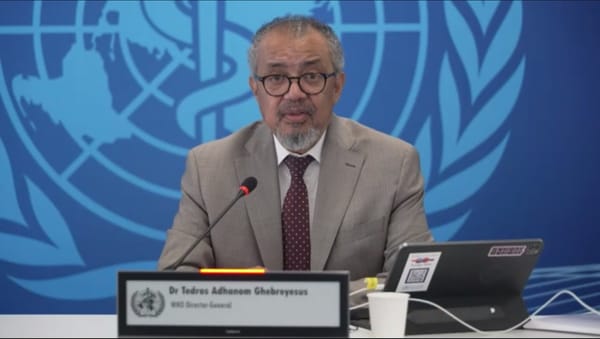
There are two wars unfolding in the Middle East right now.
The first is visible — measured in airstrikes, territory, and daily casualty counts.
The second is slower, harder to track, and far more dangerous.
It is unfolding inside hospitals, across overcrowded shelters, and within the fragile systems that keep civilian populations alive.
And according to Tedros Adhanom Ghebreyesus, the region is now entering that phase.
The latest figures presented during the WHO briefing are stark:
More than 1,400 civilians have been killed in Iran, nearly 900 in Lebanon, and dozens in Israel. Thousands more have been injured. At the same time, displacement is accelerating at scale — with 3.2 million people forced from their homes in Iran and more than one million in Lebanon.
In Syria, over 100,000 people have already crossed the border from Lebanon in recent days.
On paper, these numbers describe a humanitarian emergency.
In reality, they describe something more consequential:
the breakdown of the conditions required for survival.
One of the most alarming updates from the briefing was not the casualty count, but the confirmation that health care itself is under sustained attack.
The World Health Organization has verified dozens of strikes on medical facilities and personnel across the region. In Lebanon alone, 28 such attacks have resulted in deaths and injuries among both patients and health workers. Similar patterns are emerging in Iran and, to a lesser extent, Israel.
These are violations of international law.
But their deeper impact is structural.
When hospitals are damaged or destroyed, the consequences extend far beyond the immediate strike. Emergency care disappears. Chronic conditions go untreated. Childbirth becomes more dangerous. Routine vaccinations are interrupted.
In effect, the system that prevents deaths begins to collapse — not all at once, but in layers.
What is now taking shape follows a familiar but often overlooked pattern in modern conflict.
As displacement rises, populations concentrate in temporary shelters. These environments are frequently overcrowded, under-resourced, and poorly equipped to handle basic sanitation or medical needs.
That combination changes the trajectory of a crisis.
In these conditions, risk multiplies:
This is the moment when conflict evolves.
Not into peace — but into something quieter and more persistent.
A public health crisis that continues long after the headlines move on.
The timing of this escalation is particularly significant.
In the same briefing, the WHO highlighted one of the greatest achievements in global health: the dramatic reduction in child mortality over the past two decades. Since 2000, the number of children dying before the age of five has been cut by more than half — from over 10 million to 4.9 million in 2024.
This progress was not accidental. It was the result of sustained investment in vaccines, maternal care, nutrition, and primary health systems.
But those gains are not guaranteed.
Conflict, humanitarian strain, and funding pressures are now putting that progress at risk — particularly in regions that were already vulnerable.
In Sub-Saharan Africa alone, 2.8 million children died in 2024. Every day, approximately 6,300 newborns do not survive.
The concern is not just that these numbers remain high.
It is that the systems designed to reduce them are becoming less stable at the very moment they are needed most.
Beyond the immediate crisis, the briefing revealed subtle but important shifts in how global health risks are evolving.
WHO experts pointed to renewed concern over meningitis outbreaks — particularly among young populations living in close-contact environments. These outbreaks tend to emerge when surveillance systems weaken and population density increases, both of which are now present across parts of the region.
At the same time, updated vaccine guidance reflects a world where continuity can no longer be assumed. Adjustments to typhoid, COVID-19, and polio vaccination strategies suggest a quiet recalibration toward resilience in unstable conditions.
These are not isolated developments.
They are early indicators of a system adapting under strain.
Perhaps the most revealing moment in the briefing came when the WHO addressed Argentina’s decision to withdraw from the organization.
The response was unusually direct.
Health security, the Director-General noted, depends on universality. When countries step away from shared systems of coordination, data, and response, the risks are not contained — they expand.
This is the broader context in which the current crisis is unfolding.
Not just a regional conflict, but a moment of increasing fragmentation in the very systems designed to manage global risk.
What emerges from this briefing is not just a snapshot of the present.
It is a trajectory.
If current conditions persist, the most significant impacts of this war will not come from the next strike or the next escalation.
They will come from what follows:
These are slower, less visible, and harder to quantify.
But historically, they are often more lethal.
This is the phase of conflict that receives the least attention and demands the most understanding.
Because by the time it becomes visible, it is already deeply embedded.
The WHO briefing was not only an update.
It was a warning.
That the most dangerous stage of this war may already be underway — not on the battlefield, but within the systems that sustain life itself.
ONEST+ members receive deeper analysis on how global crises intersect — from conflict and energy to health systems and geopolitics. Explore ONEST+