“Democracy works — but only if it’s practiced,” said Eungi Hong, a presiding judge at the Gwangju District Court in South Korea.
At a time of growing global turbulence, the future of democratic systems will depend not only on the strength of their institutions, but on the consistent and active upholding of the rules that govern them.
Recent developments have shown that democracy is not tested in theory, but in moments of pressure — when legal frameworks are challenged and institutions are required to respond.
South Korea has offered a clear example of how this can be done — both efficiently and effectively.
On December 3, 2024, President Yoon Suk Yeol’s declaration of martial law posed a direct challenge to the country’s legal and political systems. The response that followed — led by constitutional procedures and judicial oversight — became a real-time test of democratic resilience.
To better understand how such systems function in practice, I spoke with Eungi Hong, a presiding judge at the Gwangju District Court and visiting scholar at Fordham Law School.
Democracy Is a Process, Not a Guarantee
“Democracy is a living process,” Hong explained — one in which power is continuously checked and responsibility is imposed.
It is not an abstract ideal, but a functioning framework. And it is most clearly revealed when tested.
In South Korea, the declaration of martial law triggered precisely such a test. While presidential authority allows for emergency measures, it is not without limits. The National Assembly holds the power to lift such declarations — and in this case, it did.
From there, the Constitutional Court assumed its role as final arbiter.
What followed was not improvisation, but sequence. Each institution operated within its defined authority, reinforcing the structure rather than destabilizing it.
This is how democracy functions: not by avoiding crisis, but by providing a system capable of responding to it.
Courts Translate Politics into Constitutional Justice
In periods of political stress, courts often become focal points of public frustration or expectation. Hong’s view, however, was clear:
“The role of the courts is not to replace politics, but to translate political conflict into constitutional justice.”
This distinction matters.
Courts do not resolve political disagreements — they determine whether actions taken within those disagreements comply with constitutional and legal requirements. In doing so, they anchor the system in law rather than outcome.
South Korea’s Constitutional Court, shaped through decades of democratic development, has been repeatedly tested through impeachment proceedings and institutional disputes. Over time, its role has become clearer: apply the law, maintain procedural integrity, and remain independent from political pressures.
Hong emphasized that this function depends not only on independence, but on process. Transparency is critical. Proceedings are public. Arguments are addressed in full. Decisions are explained in detail.
This is not only about fairness to the parties involved — it is about public trust.
Because in democratic systems, legitimacy depends not only on what is decided, but on whether people understand how and why it was decided.
Consensus as a Signal of Stability
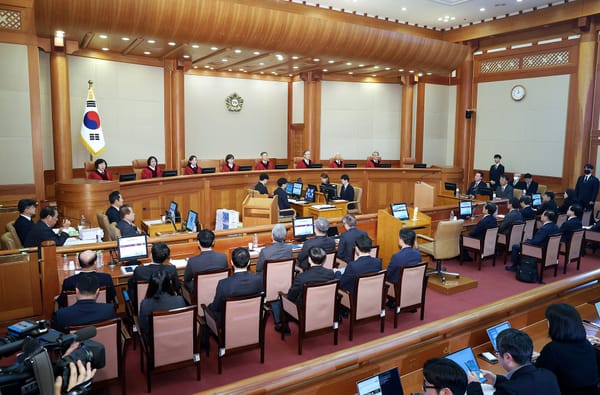
In one of the most consequential decisions — whether to remove a sitting president — the Constitutional Court reached an 8–0 ruling, with one seat vacant. Hong did not suggest that unanimity was legally necessary, but in this case, it carried weight.
In a polarized environment, unanimity signaled clarity. While individual reasoning may have differed on specific legal points, the collective decision underscored the seriousness of the constitutional violation.
It also provided stability.
At a moment of heightened political tension, the court’s unified voice helped reinforce confidence in the system — demonstrating that the process itself remained intact and credible.
When Institutions Are Challenged
For Hong, the constitutional test did not end with formal adjudication, but extended to the public response to judicial action.
Following the issuance of an arrest warrant, large-scale protests escalated into a direct confrontation with judicial institutions. Court facilities were damaged, and law enforcement officers were attacked. Participants later indicated that mobilization had occurred online, with individuals encouraging one another to take part.
Yet the disruption itself was short-lived: the situation was brought under control within roughly three hours, and those involved were subsequently criminally charged.
For Hong, this represented more than political disagreement.
It was a rejection of the constitutional system as a means of resolving disputes.
The response, however, remained grounded in law. The courts continued to function.
This is where resilience lies — not in avoiding disruption, but in maintaining institutional integrity despite it.
If political crises test democratic systems, emerging technologies may reshape them.
Hong pointed to the growing impact of artificial intelligence and misinformation on both legal processes and public trust. Courts are increasingly confronted with digital evidence that may be manipulated, incomplete, or entirely fabricated.
In one instance she cited, legal submissions included cases that did not exist — generated by AI tools.
The implications are significant. Judicial legitimacy depends on the ability to establish facts, assess evidence, and justify decisions on a reliable record. When that foundation becomes uncertain, the process itself is affected.
Following our conversation, Hong highlighted South Korea’s legislative response. The country has introduced the Framework Act on the Development of Artificial Intelligence and the Creation of a Foundation of Trust, a comprehensive effort to regulate AI while preserving public confidence in its use.
The law introduces a category of “high-impact AI” — systems used in areas such as healthcare, finance, employment, and critical infrastructure, where decisions can directly affect individuals’ rights and opportunities. These systems are subject to stricter oversight, including requirements for risk management, explainability, and user protection.
It also mandates transparency measures, including clear disclosure when AI systems are in use and labeling of AI-generated content. Violations may result in administrative penalties.
In South Korea, the question is no longer whether AI should be regulated — but how to ensure that its integration does not undermine democratic institutions.
In her broader point, the challenge is not only technological. It is institutional.
Representation, Trust, and the Judiciary
Hong also linked public confidence in courts to questions of representation.
When she began her judicial career, women accounted for roughly a quarter of judges. That number has since increased, reflecting broader access to legal education and evolving professional pathways. Yet, as she emphasized, representation remains incomplete.
“The question is not whether the court appears diverse, but whether it reflects the society it serves.”
For Hong, that question extends beyond gender. It includes regional background, socioeconomic experience, and perspective.
Hong is actively involved in advancing this work through the Judges’ Society for Gender Law of the Supreme Court of Korea — a network established in 2008 to examine gender issues arising in adjudication and to integrate those insights into judicial education, research, and policy development. Today, the society includes more than 800 members and operates across criminal, civil, family, and administrative law.
Its work extends beyond discussion. It has contributed to judicial training programs, policy-oriented research, and the development of practical guidance in areas such as sexual violence cases, digital sex crimes, and the protection of minor victims. It has also helped translate emerging legal challenges — including LGBTQ rights and reproductive rights — into judicial materials and training frameworks.
More broadly, the initiative reflects a deliberate effort to institutionalize gender sensitivity within the judiciary — not as a slogan, but as a function of legal analysis, procedural reform, and professional development.
In this context, diversity is not symbolic. It directly shapes how courts understand the cases before them — and how those decisions are received by the public.
Greater representation strengthens both the quality of judicial reasoning and the level of trust in the system itself.
The Principle That Sustains Democracy
As the conversation turns to the future, one principle remains central.
Democracy provides a framework — but it does not deliver immediate results. Its strength lies in process, continuity, and trust.
Especially in moments of stress, maintaining confidence in constitutional procedures becomes essential.
Courts must remain independent. But they must also remain connected — to the societies they serve, and to the realities those societies face.
Democracy does not fail on its own.
It weakens when it is neglected.
And when it is practiced, it still holds.
This interview is part of the ONEST Voices series, exploring the perspectives of individuals shaping today’s institutions, policy, and global conversations.