MARCH 25: War expands, oil shock deepens, and the UN revives reparations debate


“We’ll just keep bombing our little hearts out.” — President Trump
“Total annihilation is not an option.” — Qatar Foreign Ministry
123 countries back UN resolution condemning slavery and calling reparations a ‘concrete step’
KEY DEVELOPMENTS
- U.S. preparing expanded military deployment options, including airborne troops
- Gulf states shift posture toward Iran amid widening regional confrontation
- Global oil shock surpasses 1970s crisis levels, disrupting trade flows
- Iran rejects U.S. proposal and refuses direct negotiations
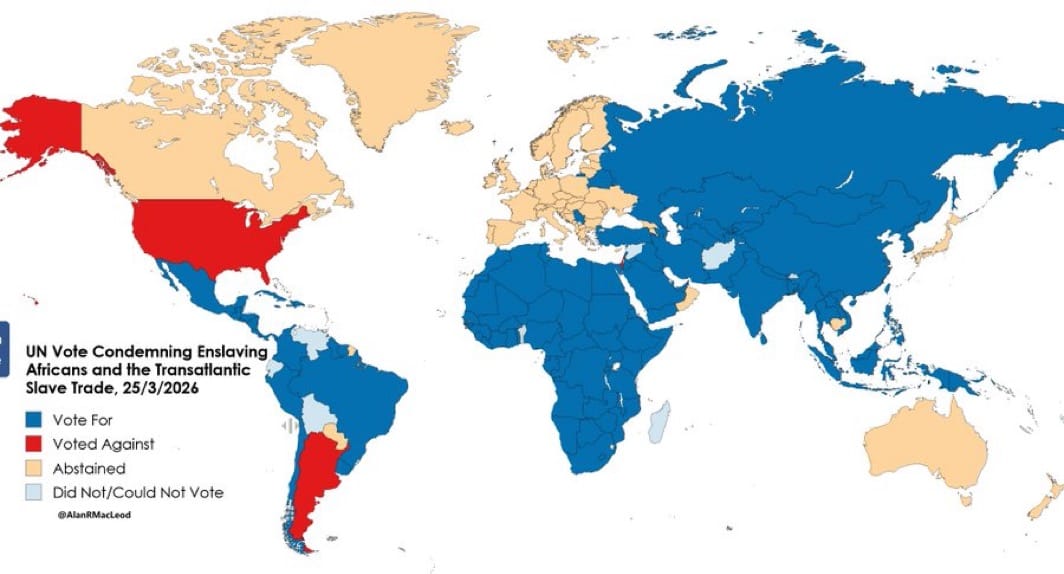
- UN adopts resolution on slavery and reparations (123–3 vote)
- Denmark prime minister resigns after historic election losses
- U.S. DHS shutdown continues to impact airports nationwide
• 3,000 — U.S. airborne troops potentially deploying
• 11 million barrels/day — oil supply disrupted globally
• $3.98/gallon — average U.S. gas price (up ~$1 in one month)
• 123–3–52 — UN vote (in favor / against / abstentions)
• 40 days — ongoing U.S. DHS shutdown
• ~1,000 drones + 23 missiles — Russia’s latest barrage on Ukraine
MIDDLE EAST — MILITARY ESCALATION, FRACTURED DIPLOMACY
Since the start of the war, U.S. military officials have been compiling daily video briefings for President Trump — highlighting the most significant and “successful” strikes on Iranian targets over the previous 48 hours.
But those briefings are selective.
Officials acknowledge that not every strike is shown, and that the material tends to emphasize operational success rather than the full scope of the conflict.
“We can’t tell him every single thing that happens,” a current U.S. official told NBC, noting that briefings tend to receive better reactions when they focus on U.S. victories.
Troop buildup and widening options
As Trump’s five-day deadline on striking Iranian energy infrastructure approaches its end on Friday:
- More than 2,000 additional U.S. Marines are expected to arrive in the region
- The Pentagon is actively considering deploying airborne forces, including a brigade of roughly 3,000 troops capable of deploying globally within 18 hours
- Elements of the 82nd Airborne Division are already preparing for mobilization, including ground forces and command units responsible for logistics and planning
According to reporting, deploying these forces does not yet signal a decision to put U.S. troops on Iranian soil — but it significantly expands the president’s military options.
Trump made clear where he stands if diplomacy fails:
“If diplomacy is unsuccessful, we’ll just keep bombing our little hearts out.”
Regional posture hardens
More than three weeks into the war, regional dynamics are shifting:
- A senior Emirati official described Iran’s restrictions on the Strait of Hormuz as an “act of economic terrorism”
- Saudi Arabia followed Qatar in expelling Iranian diplomatic personnel
- Lebanon’s foreign minister has now done the same, as fighting between Israel and Hezbollah intensifies
At the same time:
- Kazakhstan condemned Iranian missile and drone launches targeting the UAE, warning they risk further escalation
- Saudi Crown Prince Mohammed bin Salman reportedly framed the war to Trump as a “historic opportunity” to weaken Iran
There are also indications — though not formally confirmed — that the UAE could align more closely with this approach.
Contradictions and tensions among allies
Despite pressure to align:
- German President Frank-Walter Steinmeier condemned the war as a “violation of international law”
- European officials have expressed frustration at suggestions from NATO leadership that allies may follow U.S. calls to deploy naval forces to the Strait of Hormuz
Meanwhile, Qatar clarified its position:
- It is not engaged in mediation between the U.S. and Iran
- But continues to support diplomatic efforts to de-escalate the conflict
Iran rejects negotiations, sets conditions
Iran has firmly pushed back against U.S. diplomatic outreach:
- Refused to engage with Trump envoys Steve Witkoff and Jared Kushner, accusing them of “backstabbing”
- Rejected a U.S. proposal to pause the war
- Put forward its own five-point framework, including:
- Ending killings of Iranian officials
- Guarantees against future wars
- Reparations
- End of hostilities
- Full sovereignty over the Strait of Hormuz
Foreign Minister Abbas Araghchi stated:
“There are no talks with the U.S., which is sending messages through different mediators. The exchange of messages via mediators does not mean negotiation with the U.S.”
He added:
“Iran is not seeking a war… but demands a permanent end to the conflict and compensation.”
And issued a broader warning:
“We will target American interests wherever we find them, and any country that hosts them is considered a legitimate target.”
Leadership shift signals hardline direction
Iran has appointed a former Revolutionary Guards commander to replace Ali Larijani as head of the Supreme National Security Council after Larijani was killed in recent strikes — a move widely seen as reinforcing a more hardline stance.
Israel and regional actors
Israel’s UN ambassador Danny Danon stated:
- Israel is not part of any U.S.–Iran talks
- Military operations will continue
- The objective remains preventing Iran from acquiring nuclear or ballistic capabilities
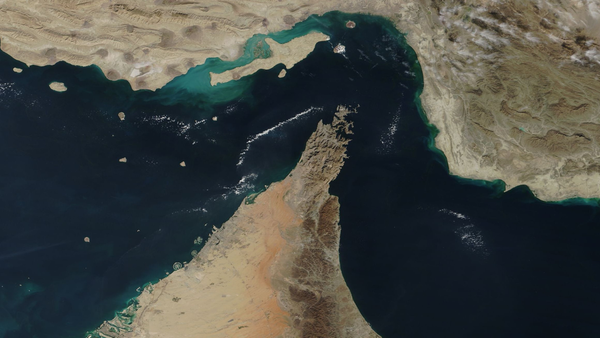
STRAIT OF HORMUZ — GLOBAL ENERGY SYSTEM UNDER STRAIN
The war is now reshaping global energy flows at scale.
According to the International Energy Agency:
- The current disruption — 11 million barrels per day — exceeds the oil shocks of the 1970s, when roughly 5 million barrels per day were lost
IEA head Fatih Birol warned that global leaders may be underestimating the severity of the situation and signaled openness to releasing strategic reserves.
Trade disruption and workaround networks
- WTO tracking shows outbound maritime traffic from the Persian Gulf has dropped to near-zero levels
- Some vessels are operating under false identities, carrying what is believed to be Iranian oil despite sanctions
- Iran has informed international bodies that “non-hostile vessels” may pass — but only if they coordinate with Iranian authorities
At the same time:
- A Thai oil tanker successfully transited the Strait without payment after diplomatic coordination
- Traders are offering Iranian oil at a premium following temporary easing of U.S. sanctions
Economic consequences spread globally
- The Philippines declared a national energy emergency, enabling extraordinary measures to secure oil imports
- Slovenia and Sri Lanka have introduced fuel rationing
- South Korea is encouraging voluntary conservation
Corporate response:
- Energy and petrochemical companies are declaring force majeure, suspending contract obligations
- BASF is raising prices on some goods by up to 30%
Consumer impact:
- U.S. gasoline prices have risen by roughly $1 in one month, now averaging $3.98/gallon
- Airlines warn fares could increase by up to 20% if fuel prices remain elevated
TotalEnergies CEO Patrick Pouyanne warned that if disruptions extend beyond three to four months, the crisis could pose a systemic risk to the global economy.
Diplomatic attempts to reopen routes
- The UK has offered to host a summit to create a coordinated plan to reopen the Strait
- The U.S. has reportedly sent Iran a 15-point proposal addressing maritime routes and broader de-escalation
Iran, however, has set conditions described by U.S. officials as “unrealistic”, including demands such as the closure of U.S. bases in the Gulf.
QATAR — POSITIONING FOR DE-ESCALATION
Qatar has taken a clear stance against escalation while acknowledging regional realities.
Foreign Ministry spokesperson Majed al-Ansari:
“Iran has been here for millennia. Nobody is going anywhere.”
“Total annihilation is not an option.”
“No people or country will disappear from existence by the wish or whim of any political actor.”
“We will live next to each other… and we have to find ways of living next to each other.”
“We will have to find a way past this.”
At the UN in Geneva, Qatar also warned that strikes on states not party to the conflict violate international law and risk wider instability.
GAZA — RISK OF BEING OVERLOOKED
Amid escalating regional tensions, UN officials warned that the situation in Gaza risks fading from international focus.
The key concern:
- Whether political and financial capacity exists to sustain reconstruction efforts
- Whether the U.S. administration can meaningfully engage while managing broader regional escalation
BROADER REGIONAL DEVELOPMENTS
- Bahrain has introduced a draft UN Security Council resolution that could authorize the use of force to protect commercial shipping in the Strait of Hormuz
- Iraq:
- Airstrikes killed at least 10 militia fighters, including a commander
- Rockets were launched toward a U.S. base in Syria — the first such attack since the war began
- Additional strikes killed Iraqi soldiers near a military facility
- Lebanon:
- Israeli strikes hit Beirut’s southern suburbs
- Israel plans to control territory south of the Litani River as a “security zone”
- Lebanon declared Iran’s ambassador persona non grata
- Hezbollah signaled it would “confront” Israeli operations
- Kuwait:
- Power transmission lines damaged by falling debris from air defense interceptions
- Türkiye:
- Says its oil dependency on the region remains “manageable”
- President Erdoğan described the war as Netanyahu’s “battle for survival that the whole world is paying for”
CHINA — CALL FOR IMMEDIATE TALKS
China continues to position itself as a proponent of de-escalation.
Foreign Minister Wang Yi urged:
- Seizing the current opportunity for peace
- Immediate negotiations
- Respect for sovereignty and regional stability
RUSSIA, ENERGY, AND GLOBAL SECURITY
- An Israeli strike targeted a Russian-linked supply line in the Caspian Sea used to transport weapons to Iran
- Approximately 40% of Russia’s oil export capacity is reportedly offline due to Ukrainian attacks and disruptions
- Russian companies Gazprom and Rosneft have been linked to the deportation and indoctrination of Ukrainian children
Russia is simultaneously expanding nuclear energy agreements:
- Deals signed with Vietnam and Uzbekistan to build nuclear power plants
UKRAINE — ESCALATION CONTINUES
Russia launched one of its largest attacks of the war:
- Nearly 1,000 drones and 23 cruise missiles in 24 hours
- Strikes hit central Lviv, including UNESCO-protected areas
- At least 7 killed, 13 injured
Ukraine highlighted:
- Continued targeting of cultural and civilian infrastructure
- The importance of digital governance systems (Diia), which have maintained state services during wartime
EUROPE — POLITICAL SHIFTS
Denmark
Denmark’s Prime Minister Mette Frederiksen has stepped down to begin coalition negotiations following an inconclusive parliamentary election, in which no political bloc secured a governing majority.
Her Social Democrats finished first — but recorded their worst result since 1903, reflecting growing domestic pressure despite her strengthened international profile during tensions with the United States over Greenland.
Frederiksen has now been appointed to lead government formation talks, as parties begin negotiations to build a coalition. The outcome remains uncertain, with smaller parties expected to play a decisive role in determining Denmark’s next government.
Italy
Voters rejected a constitutional reform backed by Prime Minister Giorgia Meloni, with about 54% opposing the measure.
The rejected reform would have fundamentally reshaped Italy’s judiciary — separating judges and prosecutors into distinct career paths, splitting oversight bodies, and introducing a new disciplinary court — changes critics warned could weaken judicial independence.
UNITED STATES — SHUTDOWN, SECURITY, AND POLICY BATTLES
The Department of Homeland Security remains partially shut down:
- Now in its 40th day
- Causing major airport delays and staffing shortages
Officials warn:
- Security lanes may be consolidated
- Smaller airports could face closures
A deal is close — but excludes ICE funding, which remains politically contested.
Policy and security tensions
- The Supreme Court appears open to allowing the Trump administration to block asylum seekers at the border
- The FCC has banned imports of certain foreign-made routers citing cybersecurity risks; waivers available
Infrastructure failure
At LaGuardia Airport:
- A runway warning system failed to alert before a collision between an Air Canada plane and a fire truck
- The system malfunctioned because the vehicle lacked a transponder
BUSINESS & TECH
- Meta ordered to pay $375 million for failing to protect children
- Apple to introduce ads in Maps
- Nintendo cuts Switch 2 production amid weakening demand
- Amazon’s Zoox expands robotaxi operations
- Spotify launches “SongDNA” feature
NASA — LONG-TERM LUNAR STRATEGY
NASA announced plans for a permanent moon base:
- $20 billion investment over 7 years
- Built through dozens of missions
Administrator Jared Isaacman:
“The moon base will not appear overnight.”
UNITED NATIONS — REPARATIONS RESOLUTION
The UN General Assembly adopted a resolution:
- Condemning slavery and the transatlantic slave trade
- Recognizing long-term impacts of colonialism
- Framing reparations as a “concrete step” toward justice
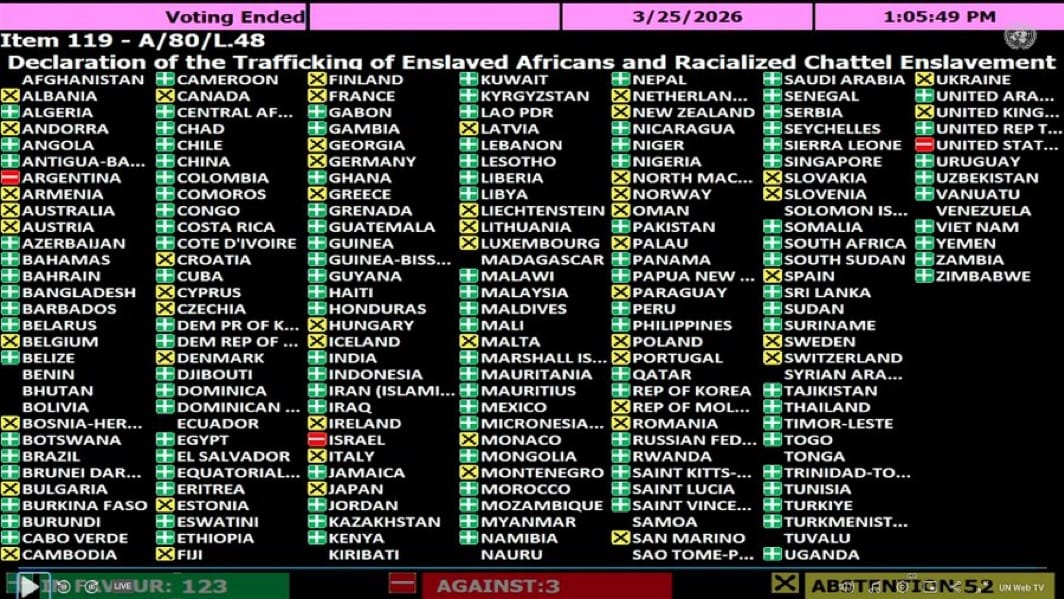
Vote:
- 123 in favor
- 3 against (U.S., Israel, Argentina)
- 52 abstentions
CHANGE
Archbishop of Canterbury — historic first
Sarah Mullally was installed on Wednesday as the Archbishop of Canterbury — the most senior cleric in the Church of England and spiritual leader of the Anglican Communion, representing around 85 million Anglicans worldwide, according to BBC reporting.
She is the first woman to hold the role.

While she formally assumed the position in January, the installation ceremony marks the symbolic beginning of her ministry. The service, attended by senior political and royal figures including the British prime minister and the Prince and Princess of Wales, drew approximately 2,000 people.
In her inaugural sermon, she emphasized the role of faith and hope, saying:
“nothing will be impossible with God.”
HUMANITY — A MOMENT
Seven dogs stolen from their owners escaped captivity and traveled approximately 17 km together, led by a corgi, across highways and fields — before finding their way home.
They made it back to their families.

Written by