MARCH 23: U.S.–Iran Tensions Shift Again, Deadly LaGuardia Collision, Israel Expands Regional Strikes

– 8 min read

Over the weekend, the situation between Washington and Tehran escalated sharply — before quickly shifting again.
On Saturday, President Trump warned that the United States would “obliterate” targets if Iran failed to fully reopen the Strait of Hormuz by Monday evening. In response, a senior Iranian official signaled retaliation, warning that facilities supplying Israel and U.S. bases could be targeted.
By Monday morning, however, the tone changed.
Trump announced that U.S. strikes on Iranian energy infrastructure would be postponed for five days, citing what he described as “productive” conversations with Tehran. He also claimed that Steve Witkoff and Jared Kushner were leading the talks.
Iran immediately pushed back.
Foreign Minister Abbas Araghchi stated:
“My last contact with Mr. Witkoff was prior to his employer's decision to kill diplomacy with another illegal military attack on Iran.
Any claim to the contrary appears geared solely to mislead oil traders and the public.”
Shortly after, Iran’s foreign ministry formally denied that any bilateral negotiations were taking place. Later in the day, officials doubled down — calling reports of talks “fake news” aimed at influencing oil markets.
Despite this, Axios reported that early-stage discussions had begun, though U.S. officials still expected two to three more weeks of fighting. Among reported U.S. demands:
Iran, in turn, indicated that restoring trade through the Strait of Hormuz would require a full halt to U.S. and Israeli military operations.
Trump, speaking publicly, framed the conflict differently:
“They call it a war, we call it a military operation.”
Later, he added:
“The Strait of Hormuz may be jointly controlled by me and the Ayatollah. Whoever the Ayatollah is.”
Meanwhile, financial markets reacted in real time.
According to the Financial Times, traders placed half a billion dollars in oil bets just minutes before Trump’s post, sending crude prices sharply downward.
Ukraine’s President Volodymyr Zelenskyy also weighed in, warning of a growing Russia–Iran link:
“There is growing evidence that the Russians continue to provide the Iranian regime with intelligence support…
By helping the Iranian regime stay afloat and strike more accurately, Russia is effectively prolonging the war.”
Hostilities continued across multiple fronts.
Israel, meanwhile, expanded its campaign.
Defense Minister Israel Katz ordered the immediate destruction of all bridges over the Litani River, accusing Hezbollah of using them for operations. He also signaled a broader strategy:
“Israel will accelerate demolition of houses in South Lebanon villages (…) in accordance with the Beit Hanun and Rafah models in Gaza.”
Over the weekend, Israel struck a key bridge connecting southern Lebanon to the rest of the country. The ongoing campaign has now killed over 1,000 people in Lebanon, according to health authorities.
Inside Iran, the situation remains harder to verify due to internet disruptions. However, independent estimates suggest more than 3,000 people have been killed since the war began.
Today, Israeli airstrikes also knocked out electricity across large parts of Tehran.
The geopolitical escalation is now feeding directly into global markets.
The U.S. lifted sanctions Friday on certain Iranian oil shipments, temporarily unlocking crude already being loaded — or set to be loaded — between March 20 and April 19.
At the same time:
In parallel, Washington warned the EU to "finalize a trade deal or risk losing favorable LNG access" — linking energy supply directly to geopolitical alignment.
Secretary of State Marco Rubio spoke today with Canadian Foreign Minister Anita Anand to discuss:
Rubio emphasized support for the UN-authorized Gang Suppression Force operating in Haiti.
A major tragedy unfolded in New York.
An Air Canada Express flight collided with a fire truck at LaGuardia Airport during landing, killing both pilots and injuring dozens.
New York Mayor Zohran Mamdani stated:
“Last night’s tragedy at LaGuardia Airport is a stark reminder: in moments of crisis, coordination across every level of government is essential…”
Early reports suggest the air traffic controller was handling both air and ground traffic simultaneously — a practice that, while not uncommon at night, raises serious safety concerns in high-traffic airports.
Transportation Secretary Sean Duffy said:
“LaGuardia is a very well staffed airport… we are a couple controllers short in total but it is a well staffed airport.”
The sequence of events points to a chain reaction:
Canadian Prime Minister Mark Carney responded:
“The collision… is deeply saddening… My thoughts are with the victims, their families, and all those impacted.”
Immigration enforcement presence expanded visibly across the country, with ICE agents deployed to more than a dozen major airports to “assist” the Transportation Security Administration. The move comes amid widespread overcrowding and operational strain.
At the same time, internal political tensions over the partial government shutdown surfaced more clearly. While President Trump has publicly blamed Democrats, Republican Senator John Kennedy acknowledged that the impasse stems directly from the White House’s position:
“He said ‘No deals with the Democrats.’ We could have had TSA paid by the end of the week. But the President said ‘No deal.’”
In Washington, the Pentagon announced a significant shift in its media policy, stating that journalists will be removed from their long-standing workspace inside the building and relocated to a separate facility. The decision comes just days after a federal judge ruled that the department’s new media restrictions were unconstitutional — raising new questions about transparency and press access.
On energy policy, the administration confirmed it will pay nearly $1 billion to French energy company TotalEnergies to abandon planned offshore wind projects in the Atlantic and instead pursue fossil fuel development within the United States — a move that signals a broader shift away from renewable expansion.
A federal judge blocked a new policy that would have allowed authorities to arrest and detain refugees who had not obtained green cards within one year of entering the country, ruling that the measure was unlawful.
Within the intelligence community, Director of National Intelligence Tulsi Gabbard is preparing a plan to move oversight of In-Q-Tel — the venture capital firm that funds advanced technologies for U.S. intelligence agencies — from the CIA to her office, potentially reshaping how emerging technologies are integrated into national security.
The White House also released a new framework for regulating artificial intelligence, proposing limits on the legal liability of AI developers while seeking to curb state-level regulation. The plan also includes provisions aimed at preventing excessive increases in consumer energy costs tied to AI infrastructure.
Meanwhile, the Pentagon confirmed that F-35 fighter jets will be delivered without radar systems for the coming months — and potentially into next year — as Northrop Grumman continues work on the next-generation AN/APG-85 radar, leaving aircraft temporarily operating with reduced capabilities.
Aleksei Volkov, a 26-year-old Russian national, was sentenced to 81 months in prison for his role in major ransomware operations targeting U.S. organizations.
He acted as an “initial access broker,” selling entry points into corporate systems to cybercriminal groups.
The attacks:
Volkov has agreed to pay $9.17 million in restitution.
A strike on a hospital in Al Daein killed 64 people, including 13 children.
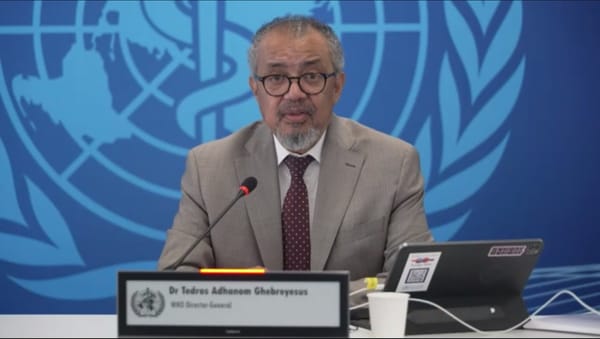
The WHO condemned the attack and called for an end to the war.
Responsibility remains disputed:
The UN described the war as:
“nearly 1,500 days of death, destruction and despair.”
Since 2022:
Recent developments:
UN official Rosemary DiCarlo warned:
“The longer the war exists, the deadlier it becomes.”
U.S.–Ukraine talks concluded in Florida without Russian participation. The Kremlin described the situation as a “situational pause.”
Zelenskyy warned that the Iran war could slow peace efforts.
Hungary has come under scrutiny after reports that its foreign minister shared confidential EU discussions with Russia.
The EU is now reportedly restricting intelligence sharing with Budapest.
Meanwhile, Hungary’s Prime Minister Viktor Orbán is receiving backing ahead of elections:
Israel’s Prime Minister Netanyahu stated:
“Viktor Orbán stands for stability, security, and protection.”
Poland’s president also signaled support, while critics warn this alignment strengthens pro-Russian influence within Europe.
Orbán’s office also issued a warning:
“Hungary will attack Ukraine if Kyiv strikes the Turkish Stream gas pipeline…”
The EU and Australia announced a major agreement covering:
European Commission President Ursula von der Leyen said:
“We are sending a strong signal… that friendship and cooperation is what matters most in times of turbulence.”
Cuba warned it is preparing for potential “military aggression” from the United States.
At the same time, the country experienced its third nationwide blackout in one month, as U.S. restrictions on oil shipments continue.
Italy has become the first country to introduce paid leave for people caring for sick or injured pets — marking a notable shift in how societies define caregiving.

This change is not just cultural — it is grounded in legal precedent.
The right stems from a 2017 court case, where an employee was granted paid leave to care for her ill dog, supported by the Italian Anti-Vivisection League (LAV). The court’s reasoning drew directly on existing law: under Article 727 of the Italian penal code, abandoning or failing to care for a suffering animal is a criminal offense.
In effect, the court recognized a contradiction — if individuals are legally required to care for their pets, they must also be practically able to do so, including during working hours.
To qualify for paid leave, employees must provide official veterinary documentation confirming that the animal requires urgent and necessary care.
More broadly, the policy reflects a deeper shift:
pets are increasingly being treated not as property, but as family members with recognized rights and dependencies.
As the policy continues to gain clarity and attention into 2026, it also removes a long-standing burden — allowing pet owners to respond to emergencies without sacrificing income or using vacation days.
In a global environment defined by conflict and instability, this is a small but telling signal of where social priorities are evolving.