MARCH 18: Middle East War Deepens, WHO Warns of Health System Collapse, U.S. Holds Rates as Global Energy Fears Rise
WHO warned of health system collapse as the Middle East war intensified, oil prices surged, and the U.S. held rates amid growing global economic pressure.
The World Health Organization warned that the Middle East conflict is pushing multiple civilian health systems toward broader collapse, with displacement, attacks on medical facilities, and emergency funding needs rising across the region.
Israel continued its campaign against senior Iranian leadership, while Iran launched fresh retaliatory strikes on Israel and expanded attacks affecting Gulf energy infrastructure.
Commercial traffic through the Strait of Hormuz remained severely reduced, keeping pressure on global energy markets and increasing concern among U.S. allies over the risk of a prolonged wider war.
Oil climbed above $103 a barrel as investors weighed attacks on energy infrastructure, while the Federal Reserve held interest rates steady amid weak job creation and broader economic uncertainty.
The war’s ripple effects spread far beyond the battlefield, with warnings on hunger, displacement, fuel shortages, humanitarian aid, and energy security across multiple regions.
NUMBERS TO WATCH
3.2 million displaced in Iran, according to WHO 1 million+ displaced in Lebanon $103.42 closing price for Brent crude 45 million additional people who could be pushed into acute hunger if the conflict continues through June 3,000 MW lost from Iraq’s grid after Iranian gas supplies stopped £15 million in new UK humanitarian support for the Middle East and surrounding region $15,000 proposed U.S. visa bond requirement for nationals from 50 countries 99.93% of the vote claimed in North Korea’s latest stage-managed parliamentary election
HEALTH CARE
Pope Leo XIV referred to universal healthcare as a “moral imperative” and called on countries to ensure such assistance is available to their citizens.
At the same time, the World Health Organization issued one of its starkest warnings yet on the regional health impact of the widening Middle East war.
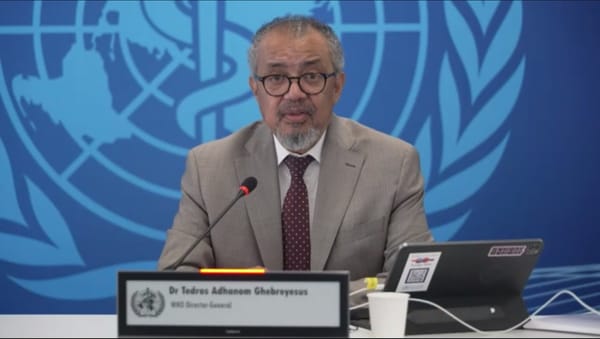
WHO briefing by Director-General
The following insights are drawn from a virtual briefing with the WHO Director-General, attended by ONEST.
The Middle East conflict is now significantly impacting civilian health systems across multiple countries simultaneously.
Large-scale displacement is creating high-risk conditions for disease spread and secondary health crises.
Attacks on health care facilities continue to be reported and verified, further weakening response capacity.
WHO has released emergency funding to support operations in Lebanon, Iraq, and Syria.
Despite ongoing response efforts, the Director-General emphasized that the current trajectory risks broader and longer-term health system breakdown.
Israel continued targeting senior Iranian leadership as the United States faced growing reluctance from allies over the war with Iran.
Israel killed top Iranian security official Ali Larijani and senior military commander Gholam Reza Soleimani yesterday. Today, Iran confirmed the death of Intelligence Minister Esmail Khatib. With three senior officials killed in two days, Israel’s campaign against Iran’s leadership is intensifying.
Analysts say Larijani’s death could further strengthen the military’s hold over Iran. His killing is also fueling new fears inside the Iranian establishment over who may be targeted next.
Iran launched fresh attacks on Israel on Wednesday, vowing revenge for the deaths of two senior Iranian leaders on Tuesday. At least two people were killed in central Israel as authorities said missiles were being intercepted in several locations, including Tel Aviv. In the predawn hours, CNN teams in the region witnessed flashes in the sky, including what appeared to be a cluster munition missile over Israel’s capital. Multiple areas in Tel Aviv were then struck by falling debris, prompting emergency and bomb disposal responses.
Yesterday, Ambassador Huckabee shared a video in which Prime Minister Netanyahu appeared to show him a “punchcard” with names he wants to see “eliminated.”
Trump is also weighing whether to seize or destroy Iran’s stockpile of near-bomb-grade nuclear material.
The Wall Street Journal separately reported that Russia is secretly supplying satellite imagery and drone technology to help Iran target U.S. forces in the region.
Spain strongly condemned the announcement by Israeli authorities that displaced Lebanese civilians would be barred from returning to their homes indefinitely.
An Israeli airstrike also hit an apartment building in central Beirut on Wednesday. The Israeli military had warned residents to evacuate roughly an hour earlier before the building was flattened at daybreak.
IRAN STRIKES QATAR AND SAUDI ARABIA’S ENERGY SECTOR
Iran launched a significant strike on Qatar’s Ras Laffan port, one of the world’s largest liquefied natural gas hubs and a critical export point for shipments to Asia and Europe.
Saudi Arabia also came under attack. Residents in Riyadh posted videos on social media, while the Saudi Defense Ministry said it intercepted four ballistic missiles.
QatarEnergy statement on missile attacks on Ras Laffan Industrial City
QatarEnergy confirmed that Ras Laffan Industrial City “has been the subject of missile attacks.”
The company said emergency response teams were deployed immediately to contain fires and that extensive damage had occurred, though all personnel had been accounted for and no casualties had been reported at the time of the statement.
Civil defense later said a fire in the Ras Laffan area had been brought under preliminary control with no injuries.
STRAIT OF HORMUZ
Commercial shipping through the Strait of Hormuz remains heavily restricted, with traffic reduced to a near-trickle.
Iran’s foreign minister said Saturday that the waterway was only closed to “those who are attacking us and their allies,” and ships from India, Pakistan, and Turkey have continued passing through since the war began. Even so, a Kuwait-flagged tanker off the coast of the United Arab Emirates was struck by a projectile today.
At an event yesterday, Trump criticized allies unwilling to join a military coalition to reopen the strait, casting them as "ungrateful after years of U.S. support". European leaders have instead continued to favor diplomatic efforts to restore passage.
The disagreement is deepening already visible strains with European allies. France, among others, has resisted Trump’s push for a naval coalition. Trump responded by saying NATO was “making a very foolish mistake” and that "the United States did not need those allies anyway".
Maritime tracking data yesterday showed a ship believed to be carrying Marines toward the Middle East had moved from Japan and was approaching Singapore. Trump also brushed aside questions about the risk of the war becoming an intractable conflict.
U.S. STRIKES
Trump claimed yesterday that the United States had destroyed all of Iran’s mine-laying vessels as part of efforts to reopen the Strait of Hormuz. He added, however, that Washington did not know whether mines had already been placed.
If the conflict continues to drive oil volatility, the International Energy Agency has indicated it is open to a second release of strategic reserves.
Axios also reported that Israel’s strike on the South Pars gas field — the world’s largest natural gas reserve shared by Iran and Qatar — was carried out with U.S. coordination and approval. The facility targeted was on the Iranian side of the field, which connects to Qatar’s North Field.
Qatar sharply condemned the strike.
Qatar MOFA Spokesperson
“Israel's targeting of facilities linked to Iran's South Pars gas field, which represents an extension of Qatar's North Field, is a dangerous and irresponsible step amid the current military escalation in the region. Targeting energy infrastructure constitutes a threat to global energy security, to the peoples of the region, and to its environment. We reaffirm, as we have repeatedly emphasized, the necessity of avoiding the targeting of vital facilities, and we call on all parties to exercise restraint, adhere to international law, and work to de-escalate in a manner that preserves the region's security and stability.”
The International Atomic Energy Agency said Iran informed it that a projectile struck the premises of the Bushehr nuclear power plant on Tuesday evening. No damage to the plant and no injuries to staff were reported. Director General Rafael Grossi reiterated his call for maximum restraint to prevent the risk of a nuclear accident.
LEBANON
The war’s displacement crisis is growing fastest in Lebanon.
More than one million people — roughly one-fifth of the population — have now been forced from their homes, according to figures released yesterday. Israel launched a ground invasion there yesterday despite a joint warning from Canada, France, Germany, Italy, and the United Kingdom about “devastating humanitarian consequences.”
IRAN–RUSSIA
Russia is deepening intelligence-sharing and military support for Iran.
According to people familiar with the matter, Moscow is supplying satellite imagery and improved drone technology to assist Tehran in targeting U.S. forces in the region. The apparent goal is to help its closest Middle Eastern partner sustain the fight against Washington and Israel, while prolonging a war that is serving Russian military and economic interests.
OIL PRICES AND ENERGY SHOCK
U.S. stocks posted a modest gain, but oil resumed its climb as attacks on energy infrastructure multiplied across the region.
Brent crude rose 3.2 percent to $103.42 a barrel, its highest closing level since 2022. While that benefits U.S. producers, the sustained rise is increasing concerns about inflation and the possibility of broader economic slowdown.
The war’s energy fallout is now affecting policy choices in multiple countries. Sri Lanka announced a four-day work week for public institutions to reduce fuel usage, becoming the latest government to alter daily life in response to war-driven energy strain. Bangladesh, Myanmar, and the Philippines have taken similar steps.
Ukraine has agreed to work with the European Union to repair and restore the Druzhba oil pipeline supplying Hungary and Slovakia after damage caused by Russian attacks.
President Zelenskyy said repairs could take one to one-and-a-half months, with the aim of resuming flows after the pipeline was suspended in January — a move that would help ease mounting energy pressure across parts of Europe.
Iraq’s Ministry of Electricity said Iranian gas supplies have stopped completely, removing more than 3,000 megawatts from the national grid after strikes on Iran’s gas infrastructure.
UN WARNING
The United Nations World Food Programme warned that the Middle East war could push 45 million more people into acute hunger if the conflict continues through June.
The agency said the war risks creating the worst disruption to lifesaving humanitarian work since COVID.
WFP’s shipping costs are already up 18 percent, and the agency says higher fuel prices mean it can purchase less food and provide less cash assistance. The WFP has already had to reduce food rations in famine-hit Sudan and can support only one in four acutely malnourished children in Afghanistan.
Another key concern is fertilizer. Roughly a quarter of the world’s fertilizer supply moves through the Strait of Hormuz, which the WFP described as now being at a virtual standstill.
WFP’s Carl Skau
“If the Middle East conflict continues through June, an additional 45 million people could be pushed into acute hunger by price rises.”
“This would take global hunger levels to an all-time record and it's a terrible, terrible prospect.”
UN climate chief Simon Stiell argued that the war’s disruption of global energy markets underscores the strategic value of renewable energy, saying it can “sidestep might-is-right politics.”
UNRWA said humanitarian needs are again rising across Gaza as aid delivery remains under severe strain.
UN teams in Yemen appealed for $2 billion to deliver lifesaving support to 12 million people, while senior UN officials told the Security Council that Syria will also need greater international support as the regional war widens.
UK AID
The United Kingdom announced £15 million in new humanitarian funding for the Middle East and surrounding region.
Half of the package will go to Lebanon, where an estimated 800,000 people have been displaced. That includes:
£3.5 million for urgent appeals in Lebanon through WFP, UNICEF, and OCHA
£2 million for the Lebanese Red Cross
£2 million for the ICRC
The remainder will support regional preparedness and displacement response, including:
£3 million for UNHCR’s Regional Refugee Response Plan
£3 million for IOM and UNICEF operations in Afghanistan
£1 million for ICRC operations in Iraq
£0.5 million for UNICEF’s emerging regional humanitarian needs
The package includes the £5 million previously announced earlier this week.
VENEZUELA
The United States is easing some Venezuela oil sanctions as the Trump administration looks for ways to increase global supply during the Iran war.
U.S. companies will now be allowed to do business with Venezuela’s state-owned oil and gas company, though restrictions remain.
Meanwhile, Nicolás Maduro’s New York court hearing was postponed to March 26 because of what officials described as logistical issues. He and Cilia Flores remain at MDC Brooklyn as legal battles continue over access to funds for his defense.
Venezuelan President Delcy Rodríguez also announced the dismissal of Defense Minister Vladimir Padrino López, a central figure in the military establishment for nearly a decade under Maduro. She thanked him for his “dedication, his loyalty to the homeland, and for having served all these years as the foremost soldier in the defense of the country,” but offered no public explanation for the change.
TÜRKIYE
NATO is deploying another U.S. Patriot missile defense system to Turkey’s southern province of Adana, where personnel from the United States and other countries are stationed at Incirlik Air Base.
Turkey’s Defense Ministry said the new deployment comes in addition to the existing Spanish Patriot system already in place there. The move follows last week’s deployment of another Patriot system to Malatya, near a NATO radar base, as missile threats linked to the Iran war continue to grow.
U.S. NEWS
The postmaster general warned that the U.S. Postal Service could be “out of cash” and unable to deliver mail in less than a year unless Congress intervenes.
The Federal Reserve kept interest rates unchanged.
Powell
“The thing a good number of people on the committee are concerned about is the very very low level of job creation. If you adjust what has been the trend job creation over the past 6 months for what we think is the overstatement due to overcounting, effectively there is zero net job creation in the private sector.”
At the Pentagon, officials said the projected cost of the Golden Dome missile defense shield has risen by another $10 billion, driven by additional demands for space-based sensing, tracking, and data transport.
A senior congressman also said the Air Force’s sixth-generation F-47 and the Navy’s F/A-XX fighter will not be available until the mid-2030s, forcing the military to keep older aircraft in service longer.
A top Pentagon official told lawmakers that existing U.S. military operations targeting Latin American drug cartels are “just the beginning” and did not rule out future ground-force deployments.
The company that organized Trump’s January 6, 2021 rally has now become the government’s highest-paid event planner.
The government shutdown is also beginning to visibly hit travel. TSA officers, working without pay, are increasingly calling out of work, creating multi-hour lines at some airports. Atlanta has urged travelers to arrive three hours early, while more than half of TSA personnel reportedly called out on Sunday and Monday at Houston airports.
Airlines are already raising prices to offset higher fuel costs caused by the Iran war.
A potentially historic heat wave is also expected to hit much of the western United States, with some areas nearing all-time April temperature records before the month even begins.
The State Department announced that nationals from 50 countries will soon need to provide a $15,000 bond for business and tourist visas, refundable if they comply with visa terms and return on time.
Full list: Algeria, Angola, Antigua and Barbuda, Bangladesh, Benin, Bhutan, Botswana, Burundi, Cabo Verde, Cambodia, Central African Republic, Cote D’Ivoire, Cuba, Djibouti, Dominica, Ethiopia, Fiji, Gabon, The Gambia, Georgia, Grenada, Guinea, Guinea-Bissau, Kyrgyz Republic, Lesotho, Malawi, Mauritania, Mauritius, Mongolia, Mozambique, Namibia, Nepal, Nicaragua, Nigeria, Papua New Guinea, Sao Tome and Principe, Senegal, Seychelles, Tajikistan, Tanzania, Togo, Tonga, Tunisia, Turkmenistan, Tuvalu, Uganda, Vanuatu, Venezuela, Zambia, Zimbabwe.
Top counterterrorism official Joe Kent has resigned over the Iran war, saying Iran posed “no imminent threat to our nation.”
Tulsi Gabbard said the intelligence community assesses that Russia, China, North Korea, Iran, and Pakistan are all developing missile delivery systems capable of bringing both conventional and nuclear payloads within range of the U.S. homeland.
Senate Republicans advanced the SAVE America Act in an initial 51-48 procedural vote, though the measure still faces major hurdles. Trump has threatened to withhold endorsements from Republicans who oppose it.
Amazon is also expanding one-hour delivery in hundreds of U.S. locations, intensifying competition with Walmart and other fast-delivery rivals.
U.S.–RUSSIA
The Trump administration believes that ending the war in Ukraine through improved relations with Russia could weaken China’s global influence.
The "strategic logic" is to pull Moscow closer to Washington through incentives such as economic ties, "thereby reducing Beijing’s long-term leverage".
CHINA TRIP DELAYED
Trump said yesterday that his planned trip to China, originally expected at the end of March, will now happen in about “five or six weeks” because of the Iran war.
He said Beijing was “fine with it,” while China’s foreign ministry said both sides remain in contact regarding the new timing.
Putin is meanwhile expected to visit China in the first half of 2026 after an invitation from Xi Jinping during a February 4 virtual meeting. He is also considered likely to attend the APEC summit in Shenzhen in November as Moscow and Beijing continue expanding strategic coordination.
CHINA–UAE
Chinese Foreign Minister Wang Yi told UAE presidential envoy Khaled Al Mubarak that the war should never have started and must not continue.
Beijing said it firmly supports the UAE in safeguarding its sovereignty and territorial integrity, condemned attacks on civilians and civilian infrastructure, and pledged to continue mediation efforts aimed at restoring stability in the Middle East.
CHINA–TAIWAN
China on Wednesday tried to use the war-driven global energy shock to advance its political message toward Taiwan.
A spokesperson for Beijing’s Taiwan Affairs Office said “peaceful reunification” would provide Taiwan with better energy security backed by a “strong motherland.”
Taiwan, which previously sourced roughly a third of its LNG from Qatar, says it has already secured alternative supplies, including from the United States, and President Lai Ching-te said imports for this month and next remain assured.
Note: this is something ONEST flagged in our deep dive at the beginning of the war against Iran.
JAPAN
Japanese Prime Minister Takaichi Sanae is set to meet Trump in Washington tomorrow.
PM Takaichi
“From now, I will be leaving for Washington, D.C. in the United States. As the security environment surrounding our country becomes increasingly severe, I will confirm with President Trump the unwavering bond between Japan and the United States and further promote cooperation across a wide range of areas, such as security and the economy, including economic security. I will also discuss the increasingly tense situation surrounding Iran.”
NORTH KOREA
North Korea’s latest so-called election has drawn ridicule online after the regime claimed 99.93 percent turnout and victory for ruling-party candidates in all 687 seats of the Supreme People’s Assembly.
With only state-approved candidates allowed, the result was entirely unsurprising — but the missing 0.07 percent quickly became the subject of jokes and memes across the internet.
0:00
/0:09
AFGHANISTAN
Afghanistan’s Taliban authorities said a Pakistani attack on a Kabul drug rehabilitation center yesterday killed at least 400 people, though the death toll remains disputed.
The BBC reported at least 100 deaths, citing unnamed forensic medicine sources in Kabul. Pakistan acknowledged carrying out strikes in Afghanistan but said they targeted only military objectives, including an ammunition depot.
The latest fighting between the two countries is now in its third week.
CUBA
Cuba suffered another nationwide blackout yesterday as fuel shortages worsened long-running structural problems in the power grid.
The U.S. has restricted oil shipments to the island while continuing pressure for political and economic liberalization. In response, Cuba’s deputy prime minister said the government would allow nationals living abroad to invest in and own businesses on the island.
President Miguel Díaz-Canel also warned that any U.S. attempt to take control of Cuba would be met with “impregnable resistance.” The warning came after Trump suggested on Tuesday that U.S. control of the island could happen “very soon.” Secretary of State Marco Rubio then said Cuba needs “new people in charge.”
Russia, for its part, condemned U.S. interference and reiterated support for Cuba. Shipping data shows a tanker carrying Russian oil is heading toward the island, even after Trump earlier threatened tariffs on countries sending fuel there.
COLOMBIA
Colombian President Gustavo Petro accused Ecuador’s military of dropping a bomb inside Colombian territory after residents near the border discovered an unexploded munition.
Ecuador carried out military operations near the frontier earlier this month, but President Daniel Noboa denied the device belonged to Ecuador.
SYRIA
Authorities in Damascus have banned alcohol in bars and restaurants outside the capital’s predominantly Christian neighborhoods.
The step reflects a more conservative turn in legal and social norms after the takeover by Islamist rebels led by current President Ahmed al-Sharaa. Critics say the move may violate elements of Syria’s constitution approved last year.
NETHERLANDS
Dutch prosecutors said four teenagers who detonated an explosive near a Rotterdam synagogue last Friday are being investigated on terrorism grounds.
In a separate incident, two people triggered an explosion outside a Jewish school in Amsterdam on Saturday.
The Netherlands also held municipal elections today.
EUROPE
The European Parliament adopted a report arguing that Europe must take greater responsibility for its own defense, calling for a stronger defense single market and describing Ukraine as a vital part of that effort.
EU foreign policy chief Kaja Kallas also signed an EU–Iceland Security and Defense Partnership, saying the agreement would deepen cooperation on maritime security and protection of critical infrastructure.
French Foreign Minister Jean-Noël Barrot said the UK would be welcomed “with open arms” if it wanted to rejoin the EU’s Single Market and Customs Union with all associated obligations.
The European Commission also unveiled EU Inc, a proposed single corporate framework intended to allow new companies to launch across the bloc in 48 hours for under €100.
European liberal political figures are meanwhile urging EU leaders to pursue a broader economic and strategic pact with Japan, Canada, and South Korea to shield trade partners from pressure by both Trump and China.
A senior British official overseeing defense reform criticized Boeing over ongoing problems with the UK’s E-7 Wedgetail airborne warning aircraft program.
The UK and Türkiye also reported progress in the fourth round of talks on an upgraded free trade agreement, with discussions covering investment, digital trade, legal services, customs, procurement, anti-corruption, labor, and the environment. Bilateral trade reached £28.3 billion in the 12 months to September 2025, up 5.8 percent year over year.
UKRAINE
The UK Space Agency and the State Space Agency of Ukraine signed their first agency-to-agency agreement, creating a formal framework for cooperation in civil and commercial space.
The deal supports ambitions laid out in the UK–Ukraine 100 Year Partnership signed in January 2025. The UK will also contribute €100,000 to joint ESA-Ukraine activities.
Ukraine also received the EU accession benchmarks for its final three negotiating clusters, meaning Kyiv now has the full set of requirements needed for the next phase of membership talks.
Norway announced $200 million in budget support for Ukraine through the World Bank’s PEACE project.
PM Svyrydenko
“We are sincerely grateful for this timely contribution, which reflects Norway’s principled leadership and steadfast support for Ukraine during this period of immense challenge.”
In Madrid, President Zelenskyy and Prime Minister Sánchez also oversaw the signing of five bilateral documents ranging from defense and infrastructure to diplomatic education and railway modernization.
Zelenskyy later met King Felipe VI and thanked Spain for sheltering 240,000 Ukrainians displaced by Russia’s war.
ZAMBIA
According to a reported State Department draft memo, the United States is considering withholding HIV aid to Zambia unless Lusaka expands U.S. access to critical minerals.
Neither the State Department nor a Zambian government spokesperson commented publicly on the report.
MYANMAR
Myanmar’s legislature opened its first session in more than five years following an election tightly controlled by the military.
Lawmakers aligned with the armed forces now hold almost 90 percent of parliamentary seats. The junta is portraying the process as a return to democracy, while critics are dismissing it as a sham meant to win sanctions relief and outside investment.
NIGERIA
Explosions in Borno state killed at least 23 civilians yesterday, according to police.
A military spokesperson blamed Boko Haram, though no group had immediately claimed responsibility.
CONGO
A Belgian court has ordered a trial for former diplomat Étienne Davignon, accused of involvement in the 1961 assassination of Congolese prime minister Patrice Lumumba.
Belgium previously apologized for its role, but no Belgian official has ever before stood trial over the killing.
NATURE
Near Kyiv, bears are emerging from hibernation after what caretakers described as the hardest winter since 2022.
At a sanctuary outside the city, two bears — Chada, a rare Tien Shan bear, and Synochok, a brown bear — have left their dens and begun moving around again, offering a rare softer image from a country still at war.
And in a lighter cross-border story: a cat has reportedly been making repeated trips between the United States and Canada using nothing but his own “pawsport.”
This briefing is part of ONEST’s ongoing coverage of global developments. For deeper analysis, behind-the-scenes notes, and access to ONEST+ briefings, you can join here.
Olga Nesterova is a journalist and founder of ONEST Network, a reader-supported platform covering U.S. and global affairs. A former White House correspondent and UN diplomat, she focuses on international security and geopolitical strategy.