There is a striking gap between how much is being done inside the international system, how much still remains unresolved — and how little of that is reflected in public coverage.
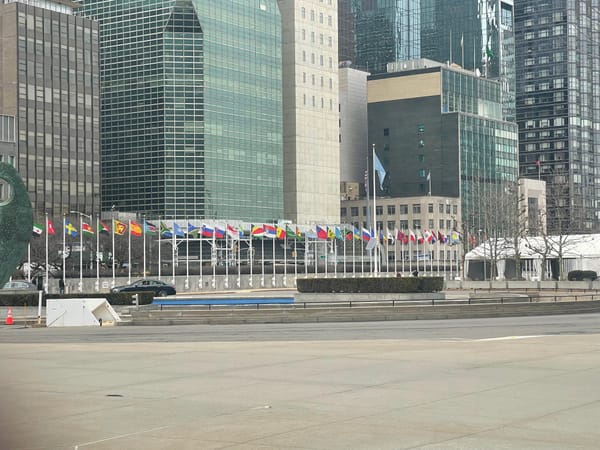
With that in mind, I spent March 9–19 at the United Nations attending multiple sessions each day — often five to seven — as part of the 70th session of the Commission on the Status of Women (CSW), the UN’s principal global forum dedicated to advancing gender equality and assessing progress on women’s rights worldwide.
Bringing together governments, UN agencies, legal experts, and civil society from across regions, CSW is where international priorities are debated, negotiated, and, in some cases, contested.
What emerged over those days was not a single narrative, but a pattern.
Across rooms, topics, and regions, discussions moved rapidly across issues that are often treated separately: war and peace, access to justice, digital violence, water, health, migration, and climate.
And yet, they kept leading back to the same question: what happens to systems and to societies when women are excluded from them?
No peace without women — and still not enough women at the table
If one phrase defined the week, it was this: no peace without women.
It surfaced immediately on day one, from Qatar to Poland, from UN Women to civil society speakers who insisted that peace cannot be built if half the population remains excluded. Patricia Elias of G100 Global put it bluntly: peace negotiated by women lasts longer, yet women still make up only a fraction of negotiators. Sima Bahous, Executive Director of UN Women, returned to the same point in different form: women are not only among those most harmed by war, but among those who sustain communities, demand justice, and carry recovery long after the cameras leave.
That message was reinforced across events focused on Ukraine, Gaza, Colombia, the Democratic Republic of the Congo, and broader Women, Peace and Security frameworks. In room after room, speakers described the same contradiction: women are at the center of resilience, service provision, local mediation, and survival, yet remain underrepresented where formal decisions are made.
At the Poland-hosted event, Ukraine’s representatives spoke not only about destruction and displacement, but about women keeping daily life together under bombardment. At the UN Women headquarters event, speakers from Palestine, Colombia, and the DRC described women not simply as victims of conflict, but as those trying to hold the social fabric together while institutions move far more slowly than the crises themselves.
The point was not symbolic. It was practical.
Peace agreements, reconstruction efforts, and justice processes are weaker when women are excluded from shaping them.
That argument is no longer theoretical inside the UN. It is widely accepted. The problem is that implementation still lags far behind the rhetoric.
The real work is in justice — and justice is where systems fail or hold
If peace was the most repeated aspiration of the week, access to justice was where the conversation became most concrete.
Some of the most substantive sessions were hosted not by the biggest powers, but by smaller and mid-sized states that spoke less in abstractions and more in institutional detail. Moldova, North Macedonia, Sweden, Türkiye, Serbia, Kazakhstan, Montenegro, and others focused on what justice actually looks like in practice: whether a woman can file a complaint without humiliation, whether she must repeat her story multiple times, whether shelters exist, whether court systems communicate with social services, whether digital platforms are accessible, whether law enforcement has the training to respond properly, and whether legislation is visible enough to inspire trust.
At the Moldova-led event, one line stayed with me: women need to know, feel, and see that the system protects them. That idea came up repeatedly in different forms. Laws on paper are not enough. Justice only becomes real when it is legible in daily life.
That same logic appeared in discussions about nationality rights, judicial representation, and the role of women judges. One session highlighted the continuing existence of gender-discriminatory nationality laws in dozens of countries, with devastating consequences for children and families who become effectively stateless. Another gathered women justices from Kiribati, Tanzania, Qatar, and global legal advocacy networks to discuss how judicial systems change when women are present not as exceptions, but as co-designers.
A consistent point emerged: women’s representation in the judiciary is not only about fairness in hiring. It changes how legal systems evolve, what harms they recognize, and how institutions are designed to serve the people who use them.
The next battleground is digital
If older barriers to justice remain painfully familiar, a newer front line is now impossible to ignore: the digital sphere.
One of the strongest sessions of the week came from the German mission, where speakers addressed deepfake pornography, digital harassment, anti-feminist online ecosystems, and the normalization of violence against women through social media. The discussion was striking not only because of the content, but because it treated digital misogyny not as a cultural side issue, but as a structural threat to democratic participation.
That framing echoed across other events as well. At Türkiye-hosted event on technological pathways to women’s access to justice, officials and experts discussed digital courts, privacy protections, AI safety, rural access, and the risks of reproducing inequality through technology that is poorly designed or weakly governed. Azerbaijan, Serbia, and others raised the same concern in different ways: technology can accelerate access to justice, but without safeguards it can also accelerate harm.
This came up again in more political form during the session on advancing young women’s leadership, and in my conversation afterward with Barcelona’s deputy mayor, where the issue was framed not only as one of inclusion, but of democratic governance. Several discussions made clear that online harassment is now one of the main barriers deterring women from entering public life at all.
That was especially visible in remarks from Finland, where officials noted that women’s political leadership is not simply stalling — in some areas, it is declining. At one event, the figure raised was stark: only 39 of the 193 ambassadors currently serving at the UN are women.
Online abuse, political polarization, and hostile public environments are not secondary issues here. They are shaping who is willing to remain visible in public life.
Funding is the quiet emergency underneath everything
There was another theme that surfaced almost everywhere, regardless of topic: the money is not there.
Funding cuts shadowed discussions on peacebuilding, women’s recovery in Ukraine, humanitarian support, judicial reform, health, agrifood systems, and support for women on the ground in conflict zones. In some cases the numbers were specific. UN Women noted that only a fraction of requested funding for women’s recovery efforts in Ukraine had been met. UNHCR officials and researchers described the consequences of broader aid cuts for refugee education and services. Multiple speakers referred to shrinking support for gender equality as one of the most serious practical threats to progress.
This was perhaps the week’s least dramatic theme, but one of its most consequential. The problem is no longer simply that governments do not know what works. In many areas, they do. The problem is the widening gap between ambitious declarations and the financing, staffing, and institutional continuity required to make them real.
That gap also helps explain why frustration was so visible in quieter conversations throughout the week. It is one thing to celebrate legal reform, digital tools, or new frameworks. It is another to implement them at scale while budgets shrink and crises multiply.
Women’s rights are not separate from water, health, food, or climate
By the final days, the conference’s boundaries had expanded even further. Water access, women’s health, food systems, and climate resilience were all treated as core women’s rights issues.
At the World Water Day event, speaker after speaker linked water directly to dignity, justice, education, and prosperity. No water, no life — but also no water, no schooling, no time, no economic participation, no safety. Women and girls remain those most burdened by scarcity, both in hours lost and in violence risk.
When women are excluded from water governance, speakers argued, the system remains blind.
The same broadening happened in health. At Denmark-led event, speakers discussed the extraordinary underinvestment in women’s health, the practical costs of late detection, and the way care systems continue to assume women will quietly absorb both economic and caregiving burdens. In agrifood discussions led by FAO and partner missions, access to justice, climate resilience, and girls’ educational opportunity were all linked directly to rural women’s roles and constraints.
In other words, CSW70 repeatedly challenged the old habit of treating women’s rights as a discrete policy category. Inside these rooms, women’s rights were discussed as infrastructure, survival, economic policy, institutional design, and democratic capacity.
Beneath the official agenda, a deeper political current
Publicly, CSW still speaks in the language of frameworks, commitments, and negotiated texts. But beneath the official agenda, there was a deeper political current running through many conversations.
The rare recorded vote early in the week exposed some of that tension openly. Off the record, it was even more visible. Diplomats and officials from multiple regions expressed concern not only about what certain major powers are saying and doing, but about how quickly anti-rights language is finding support and how poorly these shifts are often reflected in mainstream coverage.
This was one of the most striking disconnects of the week. Institutions, NGOs, and missions repeatedly raised the importance of sustained media attention — not only when something collapses, explodes, or scandals break, but while systems are being built, defended, or quietly eroded. That concern surfaced in my own questions to panelists and in their answers: too often, media highlights failure only after it becomes catastrophic.
And yet from inside the rooms, the picture looked more layered. There was real backlash. There was also real work. There were warning signs, but also committed coalitions, practical reforms, and serious people trying to defend gains that are far more fragile than many assumed.
This piece reflects only part of what was discussed inside the rooms. Throughout the week, I have also been documenting key patterns and off-the-record insights in ONEST’s
Diplomatic Notes — a series capturing how the current moment is being read across the international system, often beyond what is visible in official statements.
What CSW70 ultimately revealed
By the end of the conference, the most striking takeaway was not that the agenda had become too broad. It was that all of these issues — war, justice, digital violence, water, health, migration, food systems, and political participation — kept leading back to the same point.
When women are excluded, systems become weaker, less fair, and less able to respond to crisis.
That is both the promise and the warning of CSW70. Inside the UN, the argument linking women’s rights to peace, justice, and democratic resilience has largely been won. The harder question is whether governments are willing to fund, defend, and implement what they already claim to support — and whether the rest of us are willing to pay attention before the consequences become impossible to ignore.