Hungary’s April 12, 2026 parliamentary election is no longer just a domestic contest. It has become a test of whether Viktor Orbán’s model — nationalist at home, obstructionist in Brussels, and accommodating toward Moscow — still has enough support to survive its deepest challenge in 16 years. Independent polls published in late March and early April showed Péter Magyar’s center-right Tisza party leading Orbán’s Fidesz, though a large bloc of undecided voters means the outcome remains uncertain.
At the center of this election is a contradiction Orbán has tried to turn into a political strategy: presenting himself as the defender of Hungarian sovereignty while relying heavily on outside patrons, outside money, and outside political backing. Hungary under Orbán has depended on the European Union economically, leaned on Russian energy strategically, and is now openly receiving last-minute electoral support from the Trump administration.
The domestic reality behind Orbán’s message
Orbán has spent years building an image of stability, national pride, and resistance to Brussels. But the domestic backdrop is much less flattering. Hungary’s next government, according to S&P Global, will need to rein in social spending and repair strained state finances. Reuters reported that Hungary’s budget deficit reached nearly 40% of the full-year target in the first two months of 2026, while S&P warned that the country has suffered three years of near-stagnation and faces mounting fiscal pressure.
The European Commission’s own country forecast says inflation remained elevated, with headline inflation rising from 3.7% in 2024 to 4.3% in September 2025, while the budget deficit is projected at 4.6% of GDP in 2025. The labor market has held up better than the broader mood, but the larger picture is still one of weak growth, pressure on living standards, and limited fiscal room.
That stress is visible socially as well. Reuters reported this week that Hungarian emigration has risen sharply since Russia’s 2022 invasion of Ukraine, with younger voters citing lack of prospects, corruption, poor public services, and deteriorating education as reasons to want change. One Reuters dispatch described Hungary as “one of the poorest members of the bloc,” while younger voters interviewed described public services as “catastrophic” and Fidesz as corrupt and out of touch.
So when Orbán campaigns on external enemies, civilizational struggle, and national pride, he is also campaigning away from the fact that many Hungarians are voting with their wallets, their frustration, and increasingly, their feet.
Orbán’s alignment with Putin is not rhetorical anymore
Orbán has long tried to position himself as a realist rather than a Kremlin proxy. But Hungary’s record has moved well beyond neutral balancing.
Reuters reported on April 7 that Orbán has maintained cordial ties with Moscow throughout the war, continues to say Russian energy is essential for Hungary, and has refused to send weapons to Ukraine. The same reporting notes that Hungary has blocked a €90 billion EU loan package for Kyiv and opposed Ukraine’s EU path.
Reuters separately reported that EU leaders on March 19 failed to persuade Orbán to lift his blockade on that €90 billion package, even as the funding was described as vital for Ukraine’s war effort.
The broader political picture is even more damaging. On April 7, Reuters reported on a Bloomberg account of a leaked October 2025 phone call in which Orbán allegedly told Vladimir Putin he was effectively ready to help him and offered Budapest as a venue for summit diplomacy. Reuters noted the transcript itself was not independently verified, but the report fits a larger pattern already well established: Orbán has repeatedly broken with EU consensus, softened pressure on Moscow, and framed Russian energy not as a vulnerability but as a necessity.
His challenger Péter Magyar put the geopolitical stakes bluntly in an AP interview, calling the election a referendum on whether Hungary continues drifting toward “Eastern autocracies” or returns more clearly to Europe’s democratic mainstream.
Hungary depends on the EU even as Orbán attacks Brussels
One of the most politically revealing facts of this election is that Orbán’s anti-Brussels narrative collides directly with Hungary’s financial dependence on Brussels.
The Court of Justice of the EU’s Advocate General said in February 2026 that the European Commission should not have resumed disbursement to Hungary before required reforms were truly in force. The court press release states that, as a result of the Commission’s 2023 decision, Hungary became eligible to receive approximately €10.2 billion from various EU funds.
Reuters has also reported that opposition leader Péter Magyar is campaigning explicitly on unblocking billions in frozen EU funding, and that many of Hungary’s economic repair plans assume access to those funds. Reuters further noted that S&P expects Hungary to miss out on pandemic recovery money entirely due to time constraints.
That means Orbán’s model has become structurally contradictory: he vilifies the EU as a threat to sovereignty while the Hungarian state still needs EU money to stabilize finances, support growth, and restore credibility. This is not a side issue. It is central to why the election is so volatile.
Then JD Vance arrived
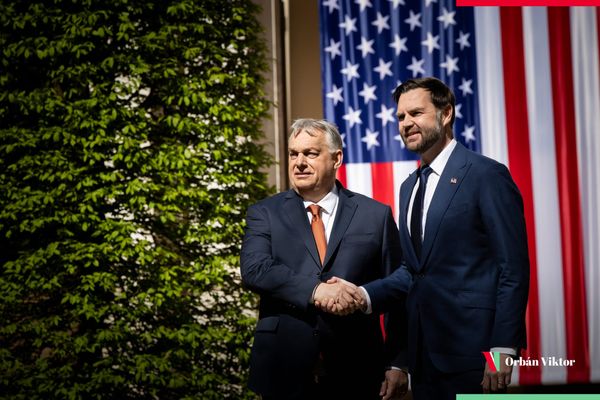
That contradiction became even sharper on April 7, 2026, when U.S. Vice President JD Vance traveled to Budapest and openly backed Orbán just days before the vote. Vance called EU conduct during the campaign “one of the worst examples of foreign election interference” he had ever seen, accused “bureaucrats in Brussels” of trying to “destroy the economy of Hungary,” and said the interference from Brussels had been “truly disgraceful.”
But Vance did not merely criticize Brussels. He openly endorsed Orbán days before the vote, joined him at a campaign rally, and called Trump from the stage so Trump could praise Orbán for doing “a fantastic job.” Vance described the U.S.-Hungary alliance as “moral cooperation” and told Hungarians he wanted them to decide their future “with no outside forces pressuring” them.
Vance told rallygoers: “We have got to get Viktor Orbán reelected as prime minister of Hungary, don’t we?” He then urged voters to “go to the polls” and “stand with Viktor Orbán.” AP described the appearance as an unusual step for a foreign leader and a break from the norm of avoiding active participation in another country’s election campaign.
That matters because it strips away the abstraction. This was not a vague diplomatic gesture. It was active, public, last-minute political support for one side in a contested election.
So what is election interference?
There is no single universally binding one-line definition used everywhere in Europe, but the broad principle is clear.
An OSCE media freedom roundtable report states that election interference can be understood as “unjustified and illegitimate ways of influencing voters’ free choices” before and during an election.
A U.S. Foreign Malign Influence Center primer distinguishes between election influence and election interference, defining election influence as efforts by a foreign government to shape election outcomes or undermine democratic processes, while reserving election interference more narrowly for degrading or disrupting the technical ability to hold an election.
That distinction is important here. If one uses the narrow U.S. technical meaning, Vance’s visit would not be “interference” in the sense of hacking machines or disrupting vote administration. But under the broader democratic-process meaning commonly used in Europe — especially when discussing foreign political pressure, manipulation, or attempts to shape voters’ choices — a sitting U.S. vice president traveling to Budapest five days before an election and explicitly telling voters to reelect Orbán clearly fits the category of foreign electoral influence, and arguably the broader concept of interference as well.
That is what makes Vance’s accusation against Brussels so politically loaded. Even if one accepts his claim that EU pressure on Hungary’s economy is politically consequential, he was himself participating directly in campaign messaging on behalf of Orbán. In practical democratic terms, that is outside intervention too.
Orbán’s argument — and the problem with it
Orbán’s core claim is that Brussels punishes Hungary politically: by freezing funds, pressuring it on rule-of-law issues, challenging its Russia policy, and backing a more compliant post-Orbán future. There is no question that the EU has used financial and legal leverage against Hungary over corruption, judicial independence, and democratic backsliding. The Commission says it is defending EU law and democratic standards; Orbán says it is ideological warfare.
But even if Orbán frames that as external pressure, it does not erase the fact that Vance and Trump crossed into direct electioneering. Reuters quoted the European Commission response succinctly: “Elections are the sole choice of the citizens.”
Where Orbán stands inside Hungary right now
As of April 7, 2026, Orbán is still politically formidable, but he is no longer politically dominant.
Reuters reported on April 1 that two independent polls showed Tisza ahead of Fidesz. One found support among decided voters at 56% for Tisza vs. 37% for Fidesz; another found 51% to 38%. Among all voters, the margins were narrower, and undecideds remained high — between 20% and 26% depending on the poll.
Reuters also noted that Orbán still benefits from friendlier polling by institutes seen as closer to the ruling camp, and that Hungary’s far-right Our Homeland party could become relevant if parliament is fragmented. Another Reuters analysis said Our Homeland may serve as a potential kingmaker even if it refuses a formal coalition.
AP described Magyar as the most serious threat to Orbán since he took office in 2010. Reuters has likewise said this is Orbán’s toughest reelection battle in 16 years.
Projection for April 12
The cleanest projection is this:
Orbán is vulnerable, but not finished.
The polling trend favors Tisza, especially among decided voters, and the direction of the race suggests genuine fatigue with Orbán’s long rule. Economic strain, corruption concerns, frozen EU funds, weak public services, and frustration among younger voters have all eroded the image of stability that sustained Fidesz for years.
But Hungary is not a normal toss-up. Orbán still controls a deeply entrenched political machine, benefits from years of institutional advantage, and knows how to turn foreign confrontation into domestic mobilization. Undecided voters remain numerous, and that alone is enough to keep this election competitive.
So the most accurate projection right now is not that Orbán is certain to lose. It is that he is facing a real possibility of defeat — and that the very fact the Trump administration felt compelled to send JD Vance to campaign for him suggests his camp understands that danger too.
Bottom line
Hungary’s election is about much more than Viktor Orbán’s next term.
It is about whether a government that claims to defend sovereignty can keep doing so while depending on EU money, Russian energy, and American political intervention.
It is about whether opposition to Brussels has become a governing model or just a cover for corruption, stagnation, and geopolitical drift.
And it is about Europe itself: because an Orbán victory would not only preserve his domestic model, but also strengthen a European spoiler who has repeatedly slowed support for Ukraine, weakened common EU positioning, and given political cover to narratives that benefit the Kremlin.
In a moment defined by Russia’s war and Trump’s instability, that would matter far beyond Budapest.