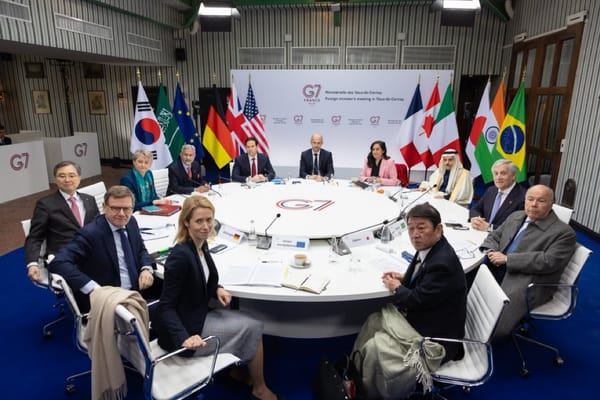
As G7 foreign ministers gathered in France on March 26–27, what was expected to be a coordination meeting instead revealed something deeper: a widening gap between public unity and private concern, and early signs of strain in the foundations of Western security cooperation.
At the center of discussions were two overlapping crises — the war involving Iran and the ongoing war in Ukraine — now increasingly linked not just by geopolitics, but by competing demands on the same military resources.
A unified message — with limits
In a joint statement released by Global Affairs Canada following the meeting in Vaux-de-Cernay, G7 foreign ministers emphasized the need to protect civilians and critical infrastructure, coordinate humanitarian efforts, and limit the regional impact of the conflict involving Iran.
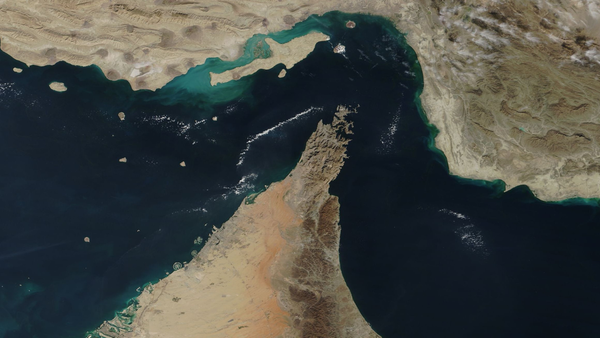
They called for an immediate cessation of attacks on civilians and civilian infrastructure, and stressed the importance of stabilizing global supply chains — including energy, fertilizer, and commercial flows — as well as restoring freedom of navigation in the Strait of Hormuz.
The statement also highlighted the need for broader coordination with international partners to mitigate economic shocks.
However, while the language is clear on humanitarian priorities and economic stability, it remains carefully calibrated. The statement avoids direct positioning on the underlying military strategy or the role of key actors, reflecting continued differences among allies on how to approach the conflict.
Fractures emerge over U.S. strategy
Tensions were most visible around the role of the United States. Marco Rubio arrived at the meeting tasked with explaining U.S. positioning in the Iran conflict, but European allies — particularly France and the United Kingdom — emphasized the need for de-escalation and diplomacy.
Officials pointed to limited consultation from Washington and growing uncertainty around U.S. decision-making. The concern is not only about the immediate conflict, but about its broader consequences for Europe’s security and economic stability.
The result is a familiar pattern: alignment in public messaging, but divergence in strategic approach.
Russia–Iran link raises the stakes
According to Reuters, European governments also raised concerns that Russia may be assisting Iran in targeting U.S. forces in the Middle East.
If confirmed, this would represent a significant escalation. It would suggest that the war in Ukraine and the conflict involving Iran are no longer separate theaters, but part of a broader, increasingly coordinated challenge. Such a development would complicate Western responses and further stretch already limited resources.
U.S. signals possible shift in Ukraine weapons supply
At the same time, reporting by Politico indicates that U.S. officials have begun warning allies that weapons deliveries to Ukraine could be disrupted in the coming months.
The U.S. State Department has reportedly informed partners that shipments of key munitions — particularly Patriot air defense interceptors — may be affected. These systems are central to Ukraine’s ability to defend against missile and drone attacks.
The issue was expected to be raised directly by Rubio during the G7 discussions. More broadly, it reflects a growing reality: U.S. military resources are being stretched across multiple active theaters.
From warning to early signals
In yesterday’s ONEST Explained, we noted that U.S. military prioritization across multiple conflicts could begin affecting existing defense commitments, including contracts with allies.
That shift is now beginning to show early signs.
Potential disruptions to Ukraine aid, combined with the reallocation of resources toward the Iran conflict and emerging tensions with partners over delivery timelines, suggest that what was previously a forward-looking risk is becoming observable policy behavior.
Growing concerns over U.S. reliability as a defense supplier
Separate reporting by SRF points to rising concern in Switzerland over U.S. defense commitments.
Switzerland had ordered Tomahawk cruise missiles, which the United States has indicated it may not be able to deliver. Swiss officials reportedly responded by halting payments. U.S. authorities are then said to have redirected funds tied to other defense purchases, including the F-35 Lightning II, intensifying political backlash in Bern.
Swiss lawmakers reacted angrily, with one warning that “trust in the USA is suffering.” While these claims are based on national reporting and political reaction and have not been fully confirmed across all official channels, they point to a broader concern now emerging among U.S. partners: that defense contracts once treated as stable commitments may increasingly be affected by shifting strategic priorities.